For many authors, the word ‘research’ may carry a negative connotation, and evoke this kind of reaction:
“Damn, now I need to stop writing, interrupt my flow and spend my precious time foraging for information on some topic I know little to nothing about.”
Luckily that thought doesn’t fracture my mind anymore. When I start drafting a work of fiction, I get excited about pulling up Google or Wikipedia or ordering a book on Amazon that will help me with facts and details about locations, time periods, culture, food, related to the story/world I am developing. I seek out friends or acquaintances that are experts on the topic or time period. I become a private investigator.
One of my suspense novels, DREAM BEACH, was set on the Tahitian island of Moorea, and partly in Northern Scotland. Fortunately, I’d been to Tahiti twice before and my favorite island to visit was Moorea. I’d also traveled to Scotland a few times around the area of Edinburgh and up the Northern coast. But I still had plenty of research to do regarding the history of the Scottish seaside town I was specifically writing about, as well as the precise location of the abandoned, yet still standing hospital and surrounding grounds, where my lead character Peyton McClintock used to hang out with her childhood chums. That abandoned hospital was a real place that I hadn’t visited. Fortunately, the on-line research provided me with scads of information and historic photographs so I could vividly portray it in my novel.
One of my secondary characters in DREAM BEACH was a Scotsman named Finn Mathews, a distinguished boat designer, company CEO, dedicated to a life and career centered around sailboats. Sure, I’ve been sailing over the years but had little clue as to the obstacles and challenges faced by sailboat racers who excel at the sport. Fortunately, one of my good friends, Rick, is a qualified expert, has sailed for many years both for fun and in racing competitions.
While in the middle of outlining my novel, Rick took me out on his boat for a day on the San Francisco Bay, and we sailed over to Tiburon. As we crossed the Bay, with Rick at the helm, he described each part of the boat, how the various devices and sails work, including the boat’s electronic features. He talked a lot about what the larger, more exotic luxury sailboats out there today are like in terms of their state-of-the-art accoutrements, and about the direction of sailboat technology for the future. Even with the wind blowing through my hair, I took notes and pics on my iPhone. When we docked, we had a nice lunch, while I asked more questions and took plenty of notes.
That day out on the bay turned into a bit of a frightening ‘boat taking on water down below’ experience on the way back from Tiburon headed to San Francisco. Fortunately, the situation was temporarily resolved “on the spot” because of Rick’s ability to employ his crackerjack skillset. Needless to say, it was intense for several minutes. Once docked, he did a more detailed analysis of the problem and planned to come back with tools and parts. He was impressive and for me, it was experiential learning. I realized that anything can happen when things go wrong on a boat. Perfect fodder for my suspense novel!
Two weeks later, I met with Rick again for another two-hour conversation about sailing. I had saved up at least a dozen more questions to ask. The answers he gave me triggered me to do even more research involving hours on Google and on websites suggested by Rick.
This research thing sounds like an overwhelming task, right? Well, at first it was no picnic but I found that the more research I did, the more I wanted to know. I was hungry for facts, phrases, verbal expressions and descriptions. For DREAM BEACH I looked for what I could use that would help make Finn, my character, come alive and be authentic as a sailboat aficionado! I collected information about sailboat maintenance routines, methods, boat designs and models, types of sails, specific annual race competitions held in the South Pacific, challenges faced sailing across oceans on mega-long sails and much more. Then, having Rick as a beta reader, as I wrote chapter after chapter, was, for me as writer, the icing on the cake.
Doing research has become a way of life for me. And doing a good amount of it ‘up front’ helps me set the stage, and may actually be relevant to the beginning of my story, with nuggets of information placed in my first chapter. Trying to go back later, after I’ve written half the book and attempting to insert “factual information” would be grueling; and I’d likely miss some opportunities for detail and have to do even more re-write.
In my latest suspense novel, DEATH IS A GREAT DISGUISER, one of my lead characters, Savannah Romeo, is a COVID-19 Contact Tracer. Once I made notes about Savannah’s personality traits and characteristics, I realized how important details about her job would be in this story. So, I enrolled myself in a Contact Tracing certification program through John Hopkins University. Yes, I got certified, aced the final exams and became a full-fledged qualified Contact Tracer. I didn’t actually pursue that as a career move but I was able to use tons of what I learned in my writing. Most important, I was able to fully develop Savannah’s character, and specifically craft her dialogue. Ok, did I go too far by getting certified? Maybe but I was curious and it was not only fun, but a worthwhile learning experience during COVID times.
One thing to keep in mind as a writer is that your research will produce an overwhelming amount of information, whatever the subject. You will have volumes of data at your fingertips which is a good thing. The trick is to distill that research, squeeze out the choice snippets of information that will add authenticity to your story without bogging it down, without going off into a miasma of swampy detail and without losing the reader. Keep in mind that sprinkling in data and facts is more desirable than dumping a boatload (excuse the pun) of facts into one chapter. This is a ‘red flag’ danger zone for the writer.
Here are some tips on the topic of RESEARCH FOR WRITING FICTION:
- Make a research plan (who to talk to, webinars, network, friends, books, articles, etc.)
- Connect with experts in that topic/field (conversations, emails, on-line, Zoom, lunch dates). Prepare ahead with questions, identifying specific things you want to know about. Make notes as you hear from experts.
- Dig deep into the details and data while interviewing to derive what you need to achieve authenticity in your character(s).
- Keep your acquired data organized. This is not a trivial activity. Decide how you will store and track data received (maybe by character or sub-topic).
- Don’t forget to research exact locations included in your story. Google Street View is a resource.
- Set yourself a deadline for ending that first big round of research. Having a balance between time spent researching and time writing is important. It’s easy to go down a rathole on the research side.
- Make a list of questions you have, in preparation for a second round of deeper, follow-up research BUT after you’ve done a good deal of writing.
- Read other novels as well as nonfiction dealing with similar subject areas.
- Appreciate the experts who shared their wisdom with you. Take them out for dinner. Include them in your Acknowledgements section. Let them know how their eagerness to share positively impacted your writing. If they are willing, ask them to read relevant chapters.
- AVOID data-dumping when you write. SPRINKLE! SPRINKLE! SPRINKLE!
Doing research for fiction is indeed a fine art. Take it seriously.
Highlights in bold italic above capture the core of this blog post!
I hope you enjoyed these 52 weeks of Write-Bytes blog posts!
I certainly learned a lot from research and from the feedback received from readers.
Thank you.
Most of us have heard the famous expression from the great philosopher Aristotle:
“The whole is the sum of its parts.”
It’s an old adage that applies to many things in life and I believe also links to writing a book.
As writers, we create our characters, a plot, and hopefully, have a theme. Our story is usually comprised of a series of events whereas our plot is a structure we use to show the connection between those events. The theme is basically the central message of our story.
If we are missing any one of these three parts, our story may fall flat, not have the “legs” or “depth” readers look for, and savor. The central theme is the “WHY” in any piece of writing, and is linked to the author searching for, and finding meaning in what s/he has written.
In my first novel, Ten Steps from the Hotel Inglaterra, the story is related to the protagonist breaking down the walls she’s built up to protect her heart after losing her younger sister to suicide. She begins her re-awakening on a solo trip to Havana, Cuba, where she allows herself to open up, be vulnerable. Then, she takes a risk which threatens her personal safety but ultimately leads her to true love. So, why did I write this story? Partly to go through my own real-life grieving process. And I wanted to show how a family tragedy can affect a person for several years, and how engaging in a self-less act to benefit a family outside one’s own can serve as part of the personal healing process. In a few words, the theme of my book is this: dealing with grief through self-less action.
Without a theme, the story can feel one-dimensional and merely a re-counting of events that happen to the characters. The setting may be intriguing, the characters colorful, the plot brilliant, but if the central theme is not decipherable to the reader, the book may disappoint. The reader may feel cheated.
Sample themes seen in great books include:
- The Kite Runner by Khaled Hosseini
Theme: Redemption, betrayal and the complex relationship between fathers and sons
- The Little Mermaid by Hans Christian Anderson
Theme: Alienation, unrequited love and “be careful what you wish for”
- The Hunger Games by Suzanne Collins
Theme: Stepping up in the face of adversity
- The Great Gatsby by F. Scott Fitzgerald
Theme: The allure of forbidden love and “money doesn’t buy happiness”
Here are some actions to help you discover the central theme of your story:
- Ask yourself, beneath the plot, subplots, characters and descriptions of places, what is this story really about? What is the main theme? Key message?
- Have one sentence or phrase that you keep in your mind as you write your story. It will help you stay on track and retain the central idea throughout your work. (e.g.: the battle between good and evil, money doesn’t buy happiness, the allure of forbidden love)
- Think about what the protagonist learns (insights gained) from going through the conflict scenario and then from resolving the conflict? Write yourself a statement about what was learned.
- Be clear on HOW the protagonist changes as a result of what s/he went through in the story? Make sure your readers will understand and see this change. The change in your protagonist should be evident in the protagonist’s dialogue, actions, thoughts as well as the narrator’s reflections. SHOW THIS vs TELL THIS in your story. Keep in mind that the change for the character doesn’t need to be a huge change. It can be “being inflexible, stubborn to becoming more flexible and less stubborn.”
Developing a powerful and CLEAR theme for your story can set your book apart from the rest.
Highlights in bold italic above capture the core of this blog post!
Stay tuned for next week. Look for this BLOG every FRIDAY which will l be posted at 9 a.m.
Next week’s WRITE-BYTES post will be titled DOING RESEARCH FOR YOUR STORY.
Working on a few writing projects simultaneously has become second nature to me. When it comes to juggling projects, I love it. I seek it out. I crave it.
What I have to be careful of is not to take on too many projects at one time. The good news for me is that I’m also a finisher. I don’t tend to start projects and leave them dangling. I seek completion and to productize results. I also edit like mad but after maybe a dozen rounds of serious editing for each chapter, I’ll call it a day, hire a reasonably priced professional proofreader at least before I make the very final edits. For short stories, I rely on myself for editing and get feedback on my work from a weekly writers’ critique group and from a small group of trusted beta readers.
Should a writer focus on one project at a time or have 2-3 of them simultaneously in process?
The answer depends on personal style, how the individual writer prefers to work. The advantage of having at least a couple of projects going at a given time is that when you’re working on a big project (like a full-length novel or memoir), you can take a break, divert your attention and craft a short story (maybe in a completely different genre) or even write a poem or a personal essay. This foray into another arena may serve to stimulate your creativity and imagination on the bigger project. It does exactly that for me.
Putting energy into the second, smaller project frees my mind, and refreshes my writing. And often, the secondary project turns out to be a well-received high-quality product. When I get back to my bigger project (the novel or memoir) I’m more inventive and considerably more focused than when I left it.
Some authors work on multiple full -blown novels at one time. Danielle Steel sometimes had five books in progress at once. There are many other well-known authors doing the same. Kristin Harmel definitely cranks out a myriad of amazing novels each year. That would likely be overload for me because having to track so many complex plots and characters in my head at a given time may not produce my best work. Perhaps I’m under-rating myself here. In reality, I have written close to 60 short stories in the past 18 months while writing my memoir and also do a weekly blog for developing writers. So, I definitely mix it up! It’s fun and feels like my personal playground.
Along my writer’s journey, I’ve collected some tips for managing simultaneous writing projects:
- Manage your time and define (before the day starts) WHAT you are going to work on that day (which may include a combination of writing and marketing/social media or submitting to lit journals)
- Be careful not to spread your creative juices too thin. If you’re writing a chapter in your novel for two hours, then maybe edit one of your short stories for the next hour and post on social media for another thirty minutes.
- Avoid falling into the danger zone where you’re not finishing any of your projects. If you have too many open, whittle down the number of separate writing ventures. (I hear a lot of this happening from other writing colleagues.)
- Pay attention to the ‘bleeding’ of characters. For example, having one character in one genre be too similar in traits and characteristics to another character in a different genre you’re working in at the same time. Keep your characters as unique as possible.
- Take a break from one writing project and outline another. That way you don’t lose a brainstormed idea or concept. Instead, you capture it. And you can go back to that outline tomorrow and shape a first draft of the first chapter or write out the whole short story.
An over-riding perk to having multiple projects going at the same time is that you will undoubtedly build your writing portfolio. Because I have ventured outside my comfort zone, I now have a diverse published body of work.
Of course, there are days when I work on only one project. I give it my undivided focus often because I am at a critical stage in the work.
Many authors also have day jobs and/or young children who depend on them so they must do conscious planning and management of their available time to write. I am a Human Resources consultant and teach classes on the subject so I am balancing those work tasks with my writing.
Most important, I need to take care of myself. There’s more to my life than writing stories but I know that writing makes me happy and feeds the creative soul inside me.
Highlights in bold italic above capture the core of this blog post!
Stay tuned for next week. Look for this BLOG every FRIDAY morning.
Next week’s WRITE-BYTES post will be DERIVING THE THEME FOR YOUR STORY.
In this digital age, getting your book title right is probably much tougher and more important than it was fifteen or twenty years ago. It’s a lot more complicated now and not just a matter of a book cover or title grabbing a reader on the bookstore shelf.
Most readers go on-line to see what book titles might be inviting and yea they might judge the book by its cover, especially by its title.
If a friend recommends a book, the reader must either write it down immediately or remember the title long enough to follow up and order it. And what they will likely “brain-retain” will be an easy to recall or unique-sounding title. So, crafting a book title that draws a crowd is tricky. I usually go with my gut and invent my book title when I have a rough skeleton outline for my novel or short story. And then that working title inspires me to write it from start to finish. It drives me. DREAM BEACH and ENDANGERED WITNESS, and FINDING SANDY STONEMEYER are examples of some of my suspense novel titles. I selected each one early on in my writing process and stuck with them through publication.
Some authors take a different approach to designing a book title. They may not title their novel until they’ve completed the first draft of the entire manuscript. I can see why that might work well. Because at that stage, they have the holistic story in their head, from beginning to end, ready to title the work appropriately.
One thing I didn’t know until I did some research on this topic is that many well-known authors have actually had their book titles changed right before publication because their publisher didn’t like the author-selected title. Here are some examples:
George Orwell’s The Last Man in Europe was changed by the publisher to 1984.
Ernest Hemingway’s Fiesta was changed by the publisher to THE SUN ALSO RISES.
Carson McCullers’ The Mute was changed by the publisher to THE HEART IS A LONELY HUNTER.
Actually, those were probably excellent changes made by publishers, right? Of course, it could go the other way where the publisher makes a poor change of title. The author had it better! I didn’t find any specific examples of this but I’ve heard published authors say this in writer association presentations and webinars, describing their dismay at their book publisher’s final selected title. But they had to go with the publisher’s decision because of their contract. Of course, self-published authors wouldn’t have this problem because they control most everything to do with their book, including title, tagline, format and pricing; but then have other challenges in terms of distribution and publicity.
So, what are the guidelines for selecting a “best fit” book title?
Here are some tips to keep in mind when thinking about your next book or short story title:
- Attention-grabbing – jumps out at the potential reader scrolling titles on a computer or phone
- Different/unique – contains a catchy, few words, even contradictory or controversial, alliterative or intriguing
- Easy to understand – not too complicated but hints at the specific genre or theme
- Memorable – something that sticks in the mind, is recognizable, not forgettable
- Easy to find in a search – does not contain skewed spelling, weird punctuation or a proper name that would be difficult to Google or locate on Amazon
- A line of prose or poetry, or short quote that’s intriguing and eye-catching
Also recommended is to get feedback on your top 3-5 brainstormed book titles. Ask your beta readers. They have read already read a complete draft of your manuscript and are in the perfect spot to give you a gut reaction for book title. And a beta reader may have an even better book title recommendation than you’ve considered.
Once you’ve finalized your title, put it to the Google test. Seek to find out if any other author has used the same title. Look internationally, including in other languages. It doesn’t mean you have to change your title but know that when a potential reader is doing a search for your book, another author’s book may come up and confuse them enough to not search further for yours.
Shakespeare is also a rich resource for authors looking for catchy book titles such as BRAVE NEW WORLD by Aldous Huxley. My most recent suspense novel was titled DEATH IS A GREAT DISGUISER, also a Shakespeare quote.
Another interesting point I came across is that usually only well-known authors get away with a one-word book title. It’s often difficult to capture the essence and flavor of a story with just one word. Examples of some incredible best-selling authors who have done it with one word are: Stephen King – IT, Toni Morrison – BELOVED, Bram Stoker – DRACULA and Ian McEwan – ATONEMENT.
I’d like to also mention something here about book title ‘taglines’. A ‘tagline’ is best described as a subtitle for your book, most often 10-15 words or even less that follow your title. The ‘tagline’ usually appears on the book cover but can instead be at the top of the back cover.
Some tagline examples from my novels are: ENDANGERED WITNESS…A San Francisco Veterinarian’s Life Turned Upside Down With Murder, Mayhem and Betrayal, DREAM BEACH…A Romantic Suspense for Dreamers, Lovers, and Troublemakers, and TEN STEPS FROM THE HOTEL INGLATERRA… A Woman’s Romantic Adventure in Havana, Cuba
The purpose of the tagline is to further pique the potential reader’s interest, pull in the target audience. If well-crafted, it will reassure the reader that the book is the right selection for them. A tagline that I truly admire is from THE HUNGER GAMES by Suzanne Collins, “Winning will make you famous. Losing means certain death.”
Let’s face it. Readers make a decision about whether to buy a book in a matter of seconds. And so, the book title and tagline chosen by the author are critically important. Choose wisely.
Highlights in bold above capture the core of this blog post!
Stay tuned for next week’s topic: Juggling Multiple Projects without Going Bananas.
Look for this blog every Friday morning.
Probably one of the most joyful activities I’ve done in terms of writing is crafting a book review. Formally, for publication, I’ve only done this three times so far. Before that, I’ve written book reviews on Facebook and Instagram, just for friends to see, usually only when I completely loved the book.
I think writing a book review might be the way to ease a writer into getting published. Why? Because you’re writing about someone and something else, a book you read from cover to cover and appreciated. Not only that but you have unique thoughts and insights into what made that reading experience work well for you. Also, you will have the opportunity to develop your skills as a reviewer. You can shape your own distinctive style of discussing the merits of a book and how it affected you as reader. Another benefit is that you might be able to build your readership before you actually publish your own novel or memoir or book of poetry.
I haven’t done this as yet but another idea is to do video book reviews on YouTube or Facebook. That will help you introduce yourself to the general public, highlighting your personality.
So, what are the guidelines for writing a compelling book review? As you might imagine, some experts say that the writer should use a repeatable structure.
For example, one seasoned book reviewer said simply this:
- Start with a short summary of the book
- Give background information about the author and topic or theme of the book
- Offer your evaluation of the book content as reviewer
Another recommendation from an experienced book reviewer said this about structure:
- Introduce the book offering with a very brief summary to include the setting
- Outline the book’s content or general storyline
- Highlight parts of the book by selecting particular chapters or themes you favored or didn’t favor as much in the story (Explain, perhaps with an engaging plot point without being a SPOILER for potential readers)
- Describe your overall evaluation of the book and give an overall rating (using stars or numerics)
I must admit and some other book reviewers might agree, that when you use a repeated structure for every book review you write, it might get a little boring to the reader, and to you as reviewer. Keep your review fresh and appear spontaneous. Others might say, it’s good to have an expected, repeatable structure that readers can anticipate. It’s a choice.
If I look at how I’ve written book reviews at this point, I think I’m more into talking about how I came to read the book, what was happening in my life when I read the book (traveling on vacation, sitting in front of the fireplace on a rainy night, etc.), how engaged I was in the storyline, my favorite sections or memorable treasures from the book and why I appreciated those elements. Then, I give my overall rating and final recommendation. For me, I prefer not to hook onto the same structure every time I write a book review. That’s just my preference as writer. And this is why I don’t generally write sequels to my suspense novels or short stories. I want to explore something different each time I write a piece. In addition, I don’t like to drag out a book review and get so detailed that my description meanders and goes down a rathole.
Two questions that frequently come up with regard to writing book reviews are these:
When I write a book review, do I need permission from the author of that book especially if I might be making money from my book review?
The general answer I found on this is: No, people write book reviews all the time on social media and websites, and other open media like Twitter. There is no requirement to ask permission from the author or publisher. But don’t quote me on this from a legal standpoint. However, I haven’t found anything that says otherwise in my research on this issue. Also, you can look up FAIR USE on the following website: www.copyright.gov
As a book reviewer, can I quote passages of the book I’m reviewing without asking the publisher or author’s permission?
The general answer I found on this is: In the U.S., book reviews are considered a category under FAIR USE. This means that you are permitted to quote copyrighted material BUT that you are expected to LIMIT the amount of text you actually use to the least amount necessary to show the point you are making. That would likely equate to a line or two, not much more.
One of the most admired sources for reputable and cogent reviews is the New York Times. We’ve all either read or heard of the NYT Book Reviews. Some well-established book critics featured in NYT have individually mentioned one or more of these tips for writing a compelling book review:
- Share your opinion and explain WHY you feel that way about the book
- Persuade the reader to pick up the book based on your learnings and insights gained from reading the book
- Consider the work’s context, how the book’s key message(s) fits into the larger cultural or social picture or the time period referenced in the book
- Try to understand the artist’s intent in writing the book, your interpretation of his/her overall intent.
Keep in mind that your book review is a reading experience in itself. It should be enjoyable to the reader even if they haven’t read the book or don’t intend to pick up the book.
If interested, here are the links to the two book reviews I’ve had published:
Book Review: THE GUNCLE by Stephen Rowley (published in Sea to Sky Review – British Columbia)
https://www.seatoskyreview.ca/january-2023-life-issue/the-guncle-book-review
Book Review: ETERNAL by Lisa Scottolines (published in Synchronized Chaos Magazine)
https://synchchaos.com/linda-s-gunther-reviews-lisa-scottolines-eternal/
Book Review: WEST WITH GIRAFFES by Lynda Rutledge
https://theravensperch.com/west-with-giraffes-a-book-review-by-linda-s-gunther/
Highlights in bold italics above capture the core of this blog post!
Look for this blog every Friday morning.
Writing is an art form. When my words sing out on the page, and my readers are specific with what they especially liked about the piece I’ve written, I am thrilled.
Recently I’ve been writing memoir stories about growing up in the Bronx in the 1960’s. The challenges to the memoir genre seem even more complex than fiction. In memoir, I must work both emotionally and technically. My hope is that my emotional journey engages readers, and that my technical skill as a seasoned writer keeps readers turning the page, hungry for the next scene. My memory of events in my childhood is not perfect but I seek to describe details and relationships as close to reality as I can get.
I believe authenticity is the cornerstone to a job well done. It requires me to dig deep, not just skim the surface with an event that happened in my childhood. I must think about: Why and how it was a significant emotional event for me? What tiny things (details) did I notice at the time it happened in terms of setting, and people’s reactions; not just my own.
A critical ingredient for writing compelling memoir is taking the more difficult step, not only reflecting on memories and events from the past, but also making sense NOW of what happened THEN. This technique is called reflective narrator
Impressive memoir writers are skilled at sprinkling in reflective narrator. The writer becomes a spectator and in essence an interpreter of events that happened long ago. In other words, the writer uses the reflective narrator tool when they analyze what happened and offer insight into what’s realized in the present day as they look back. I must admit that effectively using this tool is a challenge for me. It doesn’t come naturally.
I think what helps is writing the story in ‘first person’ which I believe easily places the writer in a perfect place with a portal to reflective narrator. It’s when I pop out of the action in the scene and speak from WHO I AM NOW. What’s required is my willingness to seek a deeper level of understanding of my behavior and actions in that scene.
I’ve noticed that memoir writers generally use reflective narrator sparingly. Sometimes it appears at the end of the description of an event or scene. It might be in the form of a summary statement. Alternatively, a writer might start a scene with a bit of reflective narrator. Here’s one example (which I haven’t used yet to begin a story but potentially may use in future):
I warn you that what happened in that barn twenty years ago on a hot August day in Louisville, Kentucky is not something I’m proud of, not something I want to be remembered by.
Two other examples which come from my published memoir work, each from a different short story are:
(from MY BASEBALL CARD COLLECTION – a short story):
I had broken my first glass ceiling at 11 years old. A gambler. I was a ‘girl’ gambler!
(from HIGH SCHOOL HEART – a short story):
I felt abandoned by the boy I loved, a feeling I’d often have again, later in life even when I was the one running away.
Both examples involve me looking back NOW at PAST events.
Reflective narrator is the writer looking for the GREATER TRUTH in their actions taken when they were a younger version of themselves, maybe a time when they were less experienced and likely with little enlightenment.
Highlights in bold italics above capture the core of this blog post!
Stay tuned for next week. Look for this BLOG every FRIDAY which will l be posted at 9 a.m.
We can all remember seeing the award-winning film, Castaway, with Tom Hanks. After crashing his plane, he’s stuck alone on a deserted island. All he’s got to comfort him is a volley ball which he aptly names Wilson. Hanks gives the object a face and some straw for hair. And in a flash, Wilson becomes a secondary character in the film. Is Wilson a pivotal character in this blockbuster? Some may argue, yes. But I don’t think that really matters.
What matters is that the audience grows attached to Wilson for a good part of the story. Wilson is not “personified,” where the ball takes on human characteristics. We don’t see the world from the volleyball’s point of view. It’s not anthropomorphic. But the presence of Wilson, an inanimate character, serves to deepen the moviegoer’s connection to the lead character’s desperate situation. Wilson represents “comfort” for Hanks who day by day strives to simply stay alive.
When I look at books that I enjoy, I notice that sometimes an author will feature one inanimate object that keeps re-appearing throughout the course of the novel. That object serves to symbolize something important to the protagonist; perhaps a struggle, a hope, an emotional conflict, a memory that scrambles their mind and will not be forgotten.
In the book, The Gold Finch by Donna Tartt, the painting is a focal point and crops up continuously as we learn about Theo, the little boy. That painting is the first painting Theo’s mother ever loved, and why he saves it from destruction. The painting serves to represent many things: genius, innocence, beauty, timelessness, and even resilience.
In a movie, the filmmaker can zero in on the inanimate object with the zoom or angle of the camera. But in a book, the author can only rely on words, either through narration or action involving the object.
There are novels where the inanimate object is in the actual title, and so it’s obvious to the reader that this place or thing will be highlighted in the story.
Examples of the inanimate objects actually appearing in a story’s title include:
The Moonstone by Wilkie Collins, where a giant diamond is the star of the story
The Purloined Letter by Edgar Allen Poe, where a letter is stolen from an unnamed royal woman
The Pearl by John Steinbeck, where the object brings bad luck to a family and ultimately leads to tragedy
In other books, the inanimate object does not appear in the book title. But the author has purposely placed it throughout the story with the intent to create a relationship between the human character and the object. This object keeps coming back into focus.
A short memoir story I recently crafted, titled Double Date features me as a young girl in the Bronx and reluctantly spending a day out at the theater one-on-one with my mother. The inanimate object that comes into play is an old tattered wristwatch my mother keeps tucked in her purse, its frayed leather wristband unusable, its oval face scratched, a few of its tiny diamonds gone. But the watch still reads perfect time and is treasured by my mother. That tiny watch symbolizes resilience and hope to my troubled mom. Looking back now, maybe I should have given that small watch a bigger role which may have serve to deepen the emotions of my lead characters. Even as I write this, I’m learning.
Inanimate objects planted in a story by an artful writer can offer readers a literary “zing.” It’s another tool to consider as you craft a good tale.
Highlights in bold italic above capture the core of this blog post!
Stay tuned for next week. Look for this BLOG every FRIDAY which will l be posted at 9 a.m.
Next week’s WRITE-BYTES post will be titled REFLECTIVE NARRATOR IN MEMOIR WRITING.
The plot for a potential story can sweep into my consciousness without me intentionally trying to manufacture one. For example, my latest protagonist, Laura Styversant, appeared in a vivid dream I had one night. I awoke, grabbed pen and paper and started to outline the story based on my dream. The protagonist I sculpted in my head was a sassy, salty, often cynical 51-year-old female private investigator who had everything go wrong for her in the last year, including a bad car accident which resulted in a broken arm, a fractured ankle, and two cracked ribs. After a four-month recovery period she’s back into the P.I. game with a ritzy new executive-level male client. It’s a challenging case for Laura. Her mission is to locate the man’s ex-wife and find out what the woman’s done with the stacks of money they hid in the wall of their last house in Long Island.
My character, Laura, is back on her feet as P.I. but there are complications in the new case causing her some stress, even more so when her client goes missing. He doesn’t answer her calls. He’s not at home where he lives. His mail is piling up. He’s nowhere to be found. Laura thinks maybe he’s intentionally ghosting her. Or maybe not. He’s already paid her a hefty fee up front but she despises unfinished business and so, becomes obsessed with finding him.
In the midst of designing the skeleton of this new short story (possibly a novel), I decided to attend a writers’ webinar focused on Crafting More Compelling Characters.
The webinar’s presenter poses this question:
“Do you interview your characters?”
The presenter goes on to say, “As a writer, you want to find out everything about your lead character; likes, dislikes, fantasies, fears, joys and more, more, more! The only way to do that is to ASK DIRECT QUESTIONS to each of your lead characters (one at a time). Just pretend you are interviewing her or him across the table. Go deep.”
My mind swirls as I listen to the presenter. When I leave the webinar, I immediately start listing specific interview questions to ask Laura Styversant, the protagonist I’m creating. Questions I come up with include these:
- Laura, what motivated you to become a private investigator?
- Do you wish you’d chosen a different line of work? As a young child, what did you want to be when you grew up?
- You seem somewhat cynical about life and a bit sassy, maybe edgy? What happened in your life to shape you this way?
- Who is the one person you’d like to have dinner with? Anyone – alive or dead? Why does that person appeal to you?
- What creeps you out, scares you, or makes you nervous?
- What would an ideal day look like for you? An ideal location for you anywhere in the world? What would you do there?
- What family member do you most admire? Connect with? What is it about them?
- What one thing or accomplishment would you like to leave as your legacy?
- What secrets do you carry from childhood? high school? Early twenties? Something you don’t want anybody to know?
- When did you have your first kiss and who with? What was the experience like?
- How would you describe your biggest regret so far in life?
That list was easy to create because I was totally curious as to how my character Laura would respond. Of course, the answers are generated from my own imagination.
But the list of questions I’ve generated helps me get “inside” the mind of my character and that’s exactly where I want to be.
Highlights in bold italic above capture the core of this blog post!
Stay tuned for next week. Look for this BLOG every FRIDAY which will l be posted at 9 a.m.
Next week’s WRITE-BYTES post will be titled INANIMATE OBJECTS AS CHARACTERS IN YOUR STORIES
How short should a short story be? If it’s flash fiction, then the guideline from the lit pub world is likely 1,000 words or less, and sometimes the specified request from a publication is that the piece be even less than 750 words. That means packing in the structure of problem-complication-resolution into quite a limited word count.
Crafting a novel offers much of the same challenge when it comes to the ‘very first line,’ the ‘hook’ that will immediately engage the reader. Let’s face it, if the reader is invested in a full-length novel or memoir, they will likely not just read the first line of the first chapter and then toss the book aside even if they’re not immediately pulled in. They will most definitely go further and at least read the whole first chapter, and maybe the next 50 pages. But if it’s a reader starting a short story and the very first line fails to capture their attention, then it is possible they will be turned off and curtail the experience. Bottomline, a short story needs a ‘scintillating’ opening.
I was attending a Mystery Writers of America – Northern California Chapter webinar with speaker John M. Floyd, author of nine novels and over 350 short stories which appear in notable publications including: Ellery Queen Magazine, Alfred Hitchcock Mystery Magazine, Strand Magazine and the Saturday Evening Post. When John M. Floyd writes a story, his thoughts first go to ‘plot.’ He starts with a brief outline. In his talk with us, he mentioned that some of his writing colleagues may tend to start with the setting or lead character when first shaping their short story. For Floyd, once he gets the general plot in mind, he then focuses on character development and how he will actually open the story with a riveting first line. Here’s an example of an opening line from his short story titled, Flu Season:
“If he’s sick,” O’Neal said, “maybe he’ll die on his own.”
So, what can we notice about this concise, well-crafted eleven-word opening sentence?
- It sucks the reader right into the action and creates tension
- It intrigues us with thoughts about what’s happening in that moment, and drives us to keep reading
- It creates a world instantly involving three characters; the narrator, O’Neal and the guy who is likely dying.
WE ARE PLUNGED INTO THAT SCENE!
Floyd went on to emphasize a most valuable tip for evolving a short story. Get the Five W’s into the front-end of the story: Who, What, Why, Where and When. Not every one of these elements need to appear in the very first line of your story. BUT for a short story to be compelling, all of those details need to flow out quickly.
Here’s another exquisite opening line from Hemingway’s Old Man and The Sea (a short novel):
“He was an old man who fished alone in a skiff in the Gulf Stream and he had gone eighty-four days now without taking a fish.”
That one line provides the reader with almost all Five W’s.
Edgar Allan Poe, a master of the short story, opened with this line in The Pit and the Pendulum:
“I was sick — sick unto death with that long agony.”
Not a pretty line but that sentence gets the reader right into the head of the narrator. It’s short and in first person. Poe is going for the jugular in that line. He’s creating ‘a sense of dread and fear’ from the get-go.
One of my all-time favorite short story authors is Raymond Carver. His down to earth style
intrigues me, instantly stimulates my emotions, glides me into a world which he develops within his opening line.
Here’s the first line from Carver’s short story, Why Don’t You Dance?
“In the kitchen, he poured himself another drink and looked at the bedroom suite in his front yard.”
Carver skillfully invites readers into the middle of a vivid scene. Upon reading this opening line, the reader will surely have questions they want answered. That one line offers quite the ‘hook.’
Tips for A Compelling Opening Line for a Short Story (from John M. Floyd and echoed by others):
- Use words that add weight to the sentence
- Resist using too many adjectives
- Define Point of View (POV) for the reader (likely use of first person or third person, etc.)
- Keep words concise, yet descriptive
- Toggle the emotions of the reader right from the start
- Create tension
- Offer the reader a compelling image
- Target an unexpected opening line
- Maybe start with a line of dialogue
Stephen King said this:
“But there’s one thing I’m sure about. An opening line should invite the reader to begin the story. It should say: Listen. Come in here. You want to know about this.”
Here’s something I’ve noticed from participating in writing critique groups over the years. To find that enticing opening line for your story, consider that the “right” line may actually appear in the third paragraph of your draft story. One of your writing colleagues may spot it, and you may hear these words from him or her:
“Your piece started for me with the first line of your third paragraph. That sentence got me right into the scene, the action, the protagonist’s perspective and her yearning. Maybe you want to open the story with that sentence.”
Of course, you are the writer! You make the decision about how to write and structure your short story. But that nugget of feedback from a colleague could be ‘golden.’ At least, consider it. Try it out. Read it aloud.
Highlights in bold italics above capture the core of this blog post!
Stay tuned for next week. Look for this BLOG every FRIDAY which will l be posted at 9 a.m.
Next week’s WRITE-BYTES post will be titled INTERVIEWING YOUR CHARACTERS
Sometimes it’s lonely being a writer. It takes hours and hours each week to write just one decent short story or chapter. Hopefully, it turns out to be riveting.
My first novel was published in 2013 and almost exactly one year before that I joined my first four-hour weekly writing critique group, made up of six or seven writers, plus me. The facilitator had written a book about writing, focused on how to open the mind to think more creatively. He usually did a short teach piece at the start of each session. Then, we spent time at the table writing individually, usually for about an hour which forced us to let it flow and write something new. During this segment, we’d each meet with the facilitator individually outside the writing room to discuss anything we wanted to about our writing. The final ninety minutes of each session was spent reading our work to each other (about ten minutes for each writer followed by about six-seven minutes of feedback). It was amazing to hear the array of work created in such a short time. Most of us were beginning writers who wanted to take the leap and get more serious about a writing project. We were encouraged to give feedback focused on what worked well in each piece that was read, what emotions were sparked in the listeners, and a few things regarding feedback on might be expanded in the piece or could have a deeper dive to engage readers even more. And that’s how I got started on my first novel, Ten Steps From the Hotel Inglaterra (a woman’s solo adventure in Havana, Cuba).
So, the question that comes to mind for me is this –
Would I have started, developed and completely writing that first novel all the way to self-publishing the book, if I hadn’t been involved in a writing critique group?
My answer –
“No, I honestly don’t think so.”
I stayed in that initial critique group for over eighteen months into the start of writing my second suspense novel (Endangered Witness).
Spending dedicated time each week with a group of writers encouraged me to continue writing and overall, invigorated my writing process. I met people who were doing an array of genres (memoir, fiction, poetry, self-help, how to, adventure, romance, and suspense. The critique group experience truly did open my mind to possibilities.
The facilitator took a break from leading the group for a while but I continued focusing on crafting novel #2. I didn’t stop writing. I couldn’t stop writing. Of course, I missed meeting with other writers each week and enjoying the facilitation of a skilled coach. So, I searched around for about four or five months and finally connected with another writing coach, someone I had met previously and respected as a writer. I’ve been in this second critique group for well over five years now (before the pandemic with face-to-face meetings, then via Zoom for the duration of the pandemic period and currently, post pandemic, continuing on Zoom). We go for eight weeks of critique sessions and then there might be a one-week break between each series. Sometimes I skip a series because of extensive personal travel. But otherwise, I’m committed.
For me, there are Seven Concrete Benefits to a Writing Critique Group:
- Motivation and support to continue writing
- Accountability each week to commit to show up, write and offer feedback to others
- Diversity of perspectives from writing colleagues with unique styles and viewpoints
- Space to share struggles and obstacles encountered as writers
- 5. Place to celebrate successes with people of like mind who want to grow their writing skill set and who seek both encouraging as well as candid constructive feedback
- Learning from listening to the work of others (dialogue, description of setting, transitions from one scene to another, building suspense, structure of a scene, etc.)
- Opportunity to experiment maybe with a new genre or something you may not have expected to write.
As Stephen King said:
“If you want to be a writer, you must do two things above all others: read a lot and write a lot.”
Participating in a writing critique group offers both of these activities. If you’re fortunate, you’ll find your tribe, people you want to stay connected with as you journey through your process!
Highlights in bold italic above capture the core of this blog post!
Stay tuned for next week. Look for this BLOG every FRIDAY which will l be posted at 9 a.m.
Next week’s WRITE-BYTES post will be titled THE OPENING LINE TO YOUR SHORT STORY
As an author, visual identity is an important success factor. And that’s why the design of the book cover is a longer-term decision than just for this book, for this one time.
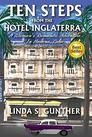
When I wrote my first novel, Ten Steps From The Hotel Inglaterra, my very talented cover designer Julie Tipton asked me, “what do you want to see on the cover?” The answer came to me instantly. I wanted an artistic rendition of the Hotel Inglaterra where I actually stayed in Old Havana, Cuba. I gave her a few photos of the hotel from a few different angles. Julie did three first draft renditions with various fonts, colors, and layouts. My favorite version was done in shades of blue with hints of a light aqua color jumping off the page and with a 1950’s classic car parked in front of the hotel. The good news is that this novel actually peaked as a best seller on Amazon for a period of time. I was thrilled and I believe I owe it to a few key components: word of mouth, having a knowledgeable marketeer and the “attraction” of the simple, clear cover design.
Had I known that I would write several more suspense novels at that time, I would have thought more broadly about my longer-term visual author identity. It doesn’t mean I’d have chosen a completely different cover design BUT maybe I would have thought more about font choice, spacing, hierarchy of what’s most important, and how my ‘author’ name appears, whether in a ‘script’ format or in ‘printed block lettering.’
Here are some Key Considerations when thinking about book cover design:
- Think long-term regarding theme, color, font, spacing, and how your name appears including location. (Think beyond the first book.)
- There are three different ways your book cover is most likely seen
- On-line: Potential readers often see just a thumbnail of your cover
- On a bookshelf – Potential readers see the spine of your book and make a nano-second judgement on whether to pull it from the bookshelf and at least look at the front cover and maybe read the back cover
- On display in a bookstore – Potential readers will hopefully spot your book cover and feel compelled to pick it up and take a look
- Target a sense of consistency in your cover designs, your opportunity to establish your unique visual identity over time
- For any book cover design, look at the balance between color, font, spacing, image vs words and PRIORITIZE each element
We want our book cover design to SHINE and CAUSE ACTION from the potential reader.
Some Basic Principles for choosing a “best in class” cover design:
- THINK SIMPLICITY – Be careful not to have too many places for the eye to focus on when seeing your book cover. You want the eye to go to PRIMARILY ONE PLACE on that cover. Which place is it? Your ‘author’ name? An object? Your book title and font?
- TEMPT WITH TONALITY – What mood are you going for with your book cover design? How are you tempting readers? What era does the book cover represent so it gives an idea as to story setting and time period? Does the cover communicate whether the book is a Mystery? Romance? Self-help guide? Business reference? Memoir?
- TUNE IN TO YOUR TARGET AUDIENCE – Assess who will likely read your book? Age group? Interests? Professions? Demographic? Gender? Genre preference? The book cover design will need to capture the attention of that audience. Also, consider what kind of emotional response you desire from that book browser at the first sight of your cover? What would cause her/him to open the book and thumb through it, whether the book is physically in hand or viewed on-line?
- PLAN THE BOOK COVER – Don’t underestimate the POWER of your BOOK COVER DESIGN. Keep in mind that our visual attention span in this 21st century world is just a few heartbeats long, somewhere around 9-10 seconds whereas some years ago it was maybe 15 minutes or longer. Compose a list of things that are important for your book cover designer to understand up-front: era, color preferences, font choice, #1 thing most important message to get across on cover, target audience demographics, possible image if desired, etc.
With so many books being published in the world today, cover design choice is a critical component for attracting readers and for long-term success!
Have a few final book cover design possibilities. TEST THEM OUT with potential readers and writing colleagues you trust. And use a draft cover design to inspire you to complete your book project. I do this and it works wonders to inspire me.
Highlights in bold italic above capture the core of this blog post!
Stay tuned for next week. Look for this BLOG every FRIDAY which will l be posted at 9 a.m.
Next week’s WRITE-BYTES post will be titled THE IMPACT OF JOINING A WRITING CRITIQUE GROUP.
For a great story, both internal and external conflict are desirable, and without one or the other the writing can feel one-dimensional or flat for the reader.
External conflict is all about threats coming from outside the character and affecting her/him.
Internal conflict comes from inside the character’s own mind. S/he struggles with their own opposing desires or beliefs. Crafting a character who is experiencing internal conflict can be an adventure for a writer. You’re sitting there at your laptop and thinking about your protagonist, debating with yourself what traits, characteristics, quirks and internal thoughts might trigger internal conflict. It must be something the reader can relate to, perceive as believable and cause them to sympathize with the character, and want to turn the page.
In my second novel, Endangered Witness, my female protagonist, veterinarian Jessi Salazar wants to be excited about her new love interest but her heart is pulling her to her ex-fiancée, who broke her heart but suddenly wants her back. She’s conflicted and then she’s thrown into a surreal scenario while on a date with the new guy. He leaves the table in the restaurant for the restroom. Jessi gazes out the window, feeling guilty and overwhelmed, on top of everything, she’s been drinking too much. Out on the quiet street below she sees a violent abduction and realizes that the nemesis may have seen her face through the restaurant window. But she’s half drunk, confused, and not sure about anything.
What we’ve got so far in this story, in just the first ten pages, is an internal conflict for the protagonist compounded by a potentially serious external threat. As the writer of this suspense novel, I was off and running at that point. A delightful place to be! From there I could go anywhere with this story, wherever my protagonist and my imagination take me.
So, what triggers internal conflict for a character? It’s usually when two of the following are happening in the character’s head at the same time:
- Need – something the character requires for survival, for basic living
- Desire – something the character personally really wants (their bottom-line motivation)
- Obligation – something the character feels a duty to do because it’s the “right” thing
- Fear – a size-able worry or safety concern experienced by the character
- Expectation from another person or group – something the character feels s/he must do because of someone else they respect or want to please
When two or more of these things occur simultaneously, a compelling internal conflict results, and the story gets juicier. The character feels fear, confusion, distress, doubt, an array of emotions, and actually stuck between those conflicting thoughts and feelings. A riveting internal conflict also has clear consequences. So, the writer must be clear on what those consequences might be for that character depending on what decisions they make.
To use internal conflict effectively in writing, here are some tips I’ve found to be helpful:
- Create your character with care (values, preferences, desires, dreams, aversions, fears, etc.). Write a detailed character description and have it in front of you as you write.
- Specifically identify the character’s goals and yearnings (what do they want).
- Introduce the internal conflict and external conflict close to one another (turn up the heat).
- Up the stakes for the character and strengthen the conflict; add more obstacles (complicate the situation for the protagonist).
- Create a turning point (include a decision time and put a clock on it).
- Show the character weighing the choices they have (don’t make it easy). Hesitation is your friend as a writer. Showing a character’s reluctance ratchets up the tension in your story and just how difficult it is for the character to make a final decision.
- Resolve the conflict (maybe have a false start and then an actual resolution which may not be all sweet and cozy).
The other valuable nugget I mined from reading about this topic is that external conflict can arise in many ways, shapes and forms, and revealed as the story moves along. BUT the protagonist’s internal conflict is something that probably sticks around throughout the story, usually until the end of the book.
Highlights in bold italic above capture the core of this blog post!
Stay tuned for next week. Look for this BLOG every FRIDAY which will l be posted at 9 a.m.
Next week’s WRITE-BYTES post will be titled BOOK COVER DESIGN IN A MULTI-MEDIA WORLD
If your house had a non-functioning furnace and you had no heat in the middle of winter, would you call a gardener to give you an assessment of the problem? No! Probably not a safe gamble.
I believe the same principle applies to requesting feedback on your writing. You want to target people who would add value, be honest, authentic, and specific in terms of what works and what could use more explanation, description or maybe emotional tension.
Your writing colleagues and those who are likely in your target audience would be ideal contenders for providing you with trustworthy feedback. So, if you’re a romantic suspense author, finding readers who enjoy that specific genre is important. And if you write memoir, feedback from people who love reading memoir and/or autobiographies is ideal.
There is no doubt that feedback is an important component of learning. Helpful feedback can also improve the writer’s confidence, and encourage her/him to try out new approaches, get out of the comfort zone and GROW! Inputs from writing coaches and constructive feedback from writing colleagues has indeed made me a better writer.
Sometimes when getting feedback in a critique group, colleagues may shower you with compliments about the piece you just read. Wow. It’s such a good feeling because they point out things you should keep doing. BUT as developing writers (and we are all developing) we want different shades of feedback that can catapult us beyond where we are today. Of course, we all want to know what is working in our writing! But we also want to know if any words or phrases maybe took the listener out of the story or details that were actually distracting or possibly muddied. We want our colleagues to point this stuff out.
When a coach suggests that maybe you, the writer, might want to ask for more specific feedback, take it seriously. Before the critique session, think about the piece you’ll be reading and what one or two questions would be helpful to ask listeners so that you get the niche area of feedback you want.
If you just want general critique, then ask “What’s working well?” Or “What could help this piece be more compelling to readers?”
Asking more specific questions might evoke more “actionable” feedback that can be pivotal to your development as a writer. Here are some examples of questions to ask:
- Does the dialogue I’ve written sound realistic? Natural? Where specifically is it working? Not working?
- How’s the clarity of the writing in this piece? Are you able to understand the sequence of events? Transitions from one scene to another? What would help bring more clarity? Any places you had confusion?
- How’s the pacing in this passage? Does it drag anywhere? Where?
- Is the setting well described? If yes, where (what words) specifically help make the setting vivid? What else would help the setting alive even more for readers?
- What words, phrases, sentences resonated most for you in this piece? Why?
- Are there places where the writing is repetitive, not necessary? Where?
When receiving feedback on your writing, I think it’s a good idea to resist the urge to explain or defend your work. Sit quietly and listen. Perhaps, take notes on what you hear. That will make it easier for you to resist responding. Of course, asking a follow-up question to get even deeper feedback is fine. I know when I get feedback on my writing, I have to be careful not to go off on EXPLAINING what I really meant in my writing.
What about bad feedback? Is there such a thing? If someone says: “Yes, I just loved what you wrote. It was great!” Hmm, that may make you feel warm and fuzzy, but it won’t necessarily provide you much concrete help. Alternatively, if another colleague tells you how they would have written your piece and then goes on to read how they’ve rewritten what you wrote, then take a pause. Think about whether you want someone to re-write a piece for you. Probably not. However, a writing coach may take a sentence you’ve written and re-structure it, suggesting that you to consider a different (maybe more interesting) way of saying what you intended.
Notice patterns when you’re getting feedback. If five people say you might consider adding more detail on the setting of your story, where the scene in your story takes place, including reference to the character’s experiences and reactions related to the five senses (smell, touch, sight,etc.), then WOW! You just had some golden flakes sprinkled on your writing. USE THAT BOOTY to take your piece of writing to the next level.
At the end of the day, the writer decides what feedback to act on and what feedback to pass on (not use). Constructive feedback helps you improve your craft BUT it shouldn’t dictate what you write or exactly how you write it. You are the commander and chief. And, some feedback may change or modify your “voice” as a writer. Your voice is your unique way of telling a story, your distinctive style, your signature. Don’t lose it because of feedback.
Not every writer is able to engage weekly or even monthly with a formal critique group and often the financial cost may be out of reach. Alternatively, or in addition to participating in a critique group, you can perhaps identify a few beta readers to review your first few chapters or even one or two trusted people who would agree to read the completed first draft manuscript of your novel, short story or memoir, and then give you specific feedback. TREASURE THE GIFT OF FEEDBACK but make your own decisions on what to use or not use. And don’t forget to leverage your GUT INSTINCTS!
Highlights in bold italic above capture the core of this blog post!
Stay tuned for next week. Look for this BLOG every FRIDAY which will l be posted at 9 a.m.
Next week’s WRITE-BYTES post will be titled DEEP DIVE ON WRITING INTERNAL CONFLICT.
Like Steven Spielberg in his film, The Fabelmans, telling stories cinematically through the lens of a camera can communicate both the overt and underlying emotions of a character. Movies are visual and composed of scenes that may be consecutive in terms of timeframe or that may go back and forth between time periods. Artfully done, a particular scene can stay with the moviegoer for months.
So, it makes sense for the writer to strive to accomplish something similar on the page but with words vs. images and audio. When an author does this well, like a good film, the book will hook and delight readers.
Scenes tell the story whether in a novel, memoir or short story. Scenes drive the plot forward and reveal each character’s motives. Every novel has a beginning, middle and end. And a scene in a book should generally follow a somewhat similar structure.
Some accomplished authors have described a good scene in a story to have an inciting incident, progressive complication(s) or crisis, and a resolution or maybe instead, a cliff hanger. Also agreed is that scenes need obstacles and a degree of conflict. That conflict may be an internal one (happening beneath the surface) or it may be an outright conflict between two or more characters. The conflict may be a subtle one but the conflict exists.
As writers, we might sometimes forget about the scene’s structure because we get lost in our writing or “wallow in the weeds.” It’s fine to go off down a meandering road when drafting a chapter, expanding as much as desired, and including all the potential descriptive details. But once the scene is down on the page, the writer needs to step back and assess whether they’ve written a cohesive scene. Take the time to look for clarity and flow in that scene. Consider whether there is a beginning, middle and ending to the scene and would trigger readers to eagerly turn the page in anticipation for the next scene or chapter.
Does writing a scene mean that the scene becomes a complete chapter in the book? Not necessarily. You may have more than one scene in a given chapter. There are no strict rules that I’ve found on this although the writer may want to stay away from having very short chapters unless going specifically for that style of writing. Some writers mix up the length of chapters on purpose to create a mood for the reader. Again, this might be a good thing to do if there’s a good reason. For example, very short chapters can create a sense of fast action and suspense.
How long should a scene be in a novel? Let’s say the novel is between 80,000-100,000 words. There is not much consensus amongst the experts on this question. Some writing teachers and coaches recommend that an individual scene be around 750 words. But some contemporary writers say a scene may run from 1,000 up 3,000 or even 5,000 words. Really, it’s the writer’s choice.
When should the writer break into a new chapter? What I’ve read on this is that the break between chapters is meant to provide a pause, to split up the narrative into smaller chunks and control the pace of the book. I like this idea and think this is a very useful guideline.
A recent personal example: I was writing a short story about my high school days back in the Bronx during the 1960’s. I wrote close to 8,000 words in this segment which was meant to become one chapter in my collection of stories to be titled A BRONX GIRL. I realized that this one short story really needed to be broken up into two stories (two separated chapters). There were too many scenes and number of words for it to be held in one chapter. After I split it in two, and read it aloud, I went back and did some re-write so that there would be a purposeful beginning, middle and end to each short story. What a great learning exercise for me!
I also did some deeper research, searching for what experienced contemporary authors have said about creating strong scenes in their books.
TIPS FOR CREATING STRONG SCENES in FICTION OR MEMOIR:
- Clearly establish the setting (time, era/date, location, physical environment, characters in the scene and how they will enter the scene).
- Think in “pictures” like a filmmaker. Images are important. What the character hears, sees, smells, and feels are premiere.
- Start your scene by placing the protagonist in a place where there is an obstacle to overcome, or an opportunity for the character’s actions in the scene to move the story to the next stage. Don’t waste the space and plug it in because you like what you wrote but it doesn’t accomplish any forward movement.
- Immerse the reader in the middle of the action but also build tension and conflict through the describing the obstacles and threats which the character is facing. There doesn’t have to be a physical threat in the scene. The threat may be part of an emotional conflict between characters or exist in one character’s mind. The inclusion of physical gesture and movement will add to the scene and help the reader to emotionally connect.
- Dialogue is your friend when writing a scene, especially when it moves the story along or exposes a deeper side to the characters in the story. We get to see what the protagonist does in stressful situations, how s/he makes decisions, how s/he reacts to others and to the physical environment. Keep dialogue crisp and as natural as possible vs. overloading with a data dump of information.
- Make the connection between the scene and the overall plot of your story. The linkage needs to be evident to the reader. For example, the scene may reveal important information or content or show another side to the character not yet divulged. Every scene in a novel or memoir must have a purpose.
- Evaluate whether your “ending sentences” in the scene tie back to the beginning of the scene. Walk around the room and read the scene aloud. Dare I say, “act it out.”
- Pay attention to the pace of your written scene. Is it dragging? Does it move seamlessly? Does it have highs and lows? Are there twists and turns, maybe some surprises?
- Writing compelling scenes can best be learned by reading, reading, reading novels and stories written by the authors you love and respect. Notice how cinematic the scenes in favorite book can be!
Get your camera out. Place it on your coffee table and start pumping your imagination. Pick up the camera. Walk around the room. Look through the camera lens and create your next amazing scene! Oh, and have a pencil handy.
Highlights in bold italic above capture the core of this blog post!
Stay tuned for next week. Look for this BLOG every FRIDAY which will l be posted at 9 a.m.
Next week’s WRITE-BYTES post will be titled RECEIVING FEEDBACK ON YOUR WRITING.
SELF-PUBLISHING YOUR BOOK
Some years ago, I had the pleasure of teaching a one-day workshop at a local college. The course was titled: Self-Publishing Your Book. Over 40 people showed up in the classroom where we had an energizing, interactive and hopefully content-rich experience. It was during the “hey day” for self-publishing.
Amazon had a wing of business called CreateSpace, an amazing resource for authors ready to take the leap into getting their book self-published and “up” on Amazon. The consultants and tech people at CreateSpace were stellar in terms of their professionalism and quality of service. They guided me through the journey which was a bit tricky. There were lots of moving parts involved and always a support phone number to call.
Did it cost $$$? Sure, but about $1,000 or thereabouts. Not catastrophic. This didn’t include the additional cost of the ISBN number which is purchased through Bowker. The CreateSpace service featured: formatting my manuscript, recommended layout, copyright, spacing, book cover design, back cover design and more.
There was also an author dashboard which still exists where I could set up my book in multiple markets across the world, decide pricing, build my book synopsis, and create my Author Central page on Amazon. I eagerly, yet awkwardly learned the tricks of the self-publishing trade. Great skills to pick up!
After writing four self-published suspense novels under my belt, in 2016, I crafted the Self-Publishing Workshop to help writers with the specific steps required in the CreateSpace process as well as how to avoid pitfalls in this process.
As facilitator of the workshop, I listened to what kind of books participants wanted to write. It was all over the map; fiction, self-help, business, how to guide, as well as memoir. Some had a manuscript close to being finished while others had a dream of writing a book and a concept in mind. So, I had everyone craft a skeleton of what they each imagined as their end product (book title, cover design, tagline, bare bones plot or key message targeted). For many, it was their first time laying out a framework for their dream book. They left the workshop with a “kit” for self-publishing and a more solidified vision for their own project.
Of course, nothing stays the same and CreateSpace as we knew it was shut down by Amazon not long after I presented the workshop. However, they still retained the author dashboard, a great tool which transitioned over to Kindle (KDP).
At that point, manuscript format, font choice, pagination, book cover art/font or layout services were no longer available from Amazon or KDP. However, an author could upload their camera-readied front and back book cover and formatted manuscript, and get their book published for both Amazon and Kindle. But any layout or formatting needed meant that the author had to either contract with a middleman to meet the exact Amazon readiness requirements, or do it themselves. Not easy.
After CreateSpace shut down, I had to research other options and decided to use semi-hybrid publishing services to get my books formatted to meet the unique standards required from Amazon. It became a more complicated, piecemeal process. For my next book project, I worked with a high-quality service provider in Colorado. They did all the layout and formatting at a higher cost than Createspace, but did a great job. For another book I worked with a bookstore which was a somewhat convoluted process and not too favorable in terms of making a decent financial return on book sales.
Yet again, things changed. KDP has decided to come to the rescue. I’m guessing they listened to feedback from frustrated authors. And now, I believe, they are offering a more comprehensive array of services, including book formatting, layout, manuscript upload readiness and “go live” services which were once provided by CreateSpace.
I am currently in the final stage with my memoir which will be titled A BRONX GIRL (a collection of short stories about “growing up in the Bronx during the 1960’s”). So, I may indeed seek out the full range of KDP services for this next self-publishing adventure. Or, I may decide to go the more traditional publishing route and hold out for a big-time publisher to pick up my book.
Should you decide to take the self-publishing route, here are some tips that may be helpful:
- Edit your manuscript with feedback from beta readers and editors. (Only YOU can do this!)
- Have your manuscript formatted for both e-book and print. (This is so important.)
- Connect with a book cover designer. (You will need this for both front and back cover.)
- Get your author website designed and “up” because it will be the foundation of your marketing platform. (Hire a web designer or acquire an app and develop skills to do this.)
- Figure out your overall marketing strategy before your book is out there.
- Review your book proof carefully.
- Acquire your ISBN number from Bowker. (This is required for your book to be specifically identified and traceable.)
- Keep in mind that there are lots of options out there for self-publishing. (Alternatives include Ingram Spark, KOBO, Barnes and Noble Press as well as many other smaller presses.)
- Pop the cork when your book goes “live.”
Remember that a self-published book can actually become a best-seller! It’s an Indie way of making it happen.
One caveat: be aware that there are publishing and marketing scams out there, so don’t take a cold call or email at face value. Do research on anything that seems too good to be true:-)
Highlights in bold above capture the core of this blog post!
Stay tuned for next week. Look for this BLOG every FRIDAY which will l be posted at 9 a.m.
Next week’s WRITE-BYTES post will be titled CINEMATIC SCENES IN YOUR STORY.
Learn from the wise and thrive. That’s my writer’s motto. On the other hand, go where your own creative energy takes you. I try to blend these two approaches. I savor the golden nuggets I get from the experts on the craft of writing. But I also use my gut and trust and honor my unique writer’s “voice.”
I was fortunate to attend an excellent Sisters in Crime webinar with Catriona McPherson who writes mysteries set in the 1930’s as well as contemporary psychological thrillers. Everything I got from her session was valuable for me as a suspense novelist.
In this blog post, I’ll dig into PLANTING CLUES, the focus of Catriona’s presentation.
Catriona began her talk with the three questions inherent in every mystery: How dunnit? Why dunnit? and When dunnit? She, then, zeroed in on the methods available to writers for inserting clues as the story unfolds.
Some of the content gems I picked up from Catriona’s engaging presentation include the following:
- The writer can plant or hide CLUES in a variety of ways:
- In the details (maybe insert a detail that refers to who dunnit, why dunnit or when dunnit)
- In humor (a joke or funny vignette told by a character)
- In a character’s attitude about something (how s/he observes or experiences a situation)
- In the point of view (how the writer decides to tell the story either from the narrator’s voice, from the protagonist’s voice or otherwise)
- In the subplot to the story (something related to a secondary background plot)
- In a sex scene (maybe something noticed by a character during intimacy, could be a small detail)
- The writer can also plant clues by omitting information. For example, a dog who doesn’t bark in the middle of the night. A character may point out how odd that is, which may turn out to be an important clue for the reader.
- In planting CLUES, use the RULE OF 3! Only plant clues 3 TIMES in the whole book. Otherwise, the writer is overusing “clues.” Insert a clue once EARLY ON, once MID-WAY and then once LATE in the story. 3 CLUES and that’s it.
What was so interesting to me was that Catriona suggested that the first clue the writer plants should be done before the reader even cares; literally when the reader may have no idea that it might even be a clue. This was a very helpful tidbit of advice for me as a suspense writer.
Now, I’m eager to go back to each of my six published suspense novels and check for when and how I’ve inserted clues or used any type of foreshadowing. Foreshadowing is a form of providing clues, but a more subtle technique than actually giving a clue. I have found that sometimes, while writing, I inadvertently foreshadow something that will happen later in my story. Perhaps it was lingering in my subconscious and then somehow it comes out on the page. When I read back the chapter or scene, I realize that indeed, I planted a clue or used foreshadowing. Catriona recommends that writers be intentional when giving clues or foreshadowing. For me, I may have done this sometimes accidentally.
Another topic that Catriona touched on was the possible inclusion of a “red herring” in the story. This refers to when the protagonist derives that something is a CLUE regarding who committed the crime or murder, BUT gets it all wrong. The example Catriona gave was this one: A stranger arrives at a wedding at around midnight and everyone assumes he’s the likely murderer. After all, who shows up at midnight? What’s his motive to arrive so late? He appears to be the guilty one based on his behaviors and awkward timing. But in reality, it turns out that he had nothing to do with the murder. The author has craftily introduced a “red herring.”
Catriona’s presentation triggered me to think more about the reader’s experience. Of course, we want our readers to have a rich and intense adventure. Here are some emotions which I hope my readers feel when jumping into one of my suspense novels:
- Worry or anticipation about what might happen next in the story
- Some feeling of anxiety or discomfort (especially right before or when the threat or danger is happening)
- Curiosity about what has already occurred in the story (more details/information not yet revealed by me, the narrator)
- Yearning to discover the ultimate outcome for the lead and secondary characters
- Satisfaction with how loose ends have been tied up (whether positive or negative) for characters in the story, leaving no dangling issues to be resolved (unless it’s a tease for the next book)
The goal for a mystery or suspense novelist is to successfully stimulate the reader’s empathy and concern for the main characters in the story. Is the reader rooting for our protagonist? And, how do we, as writers get the reader to that point?
In doing more research, I was reminded that in the film Back to the Future, during the opening credits, an actor is seen hanging from the minute hand of a clock. This one visual foreshadows Doc Brown hanging from the clock tower later in the movie as he attempts to send Marty McFly back to the 1980’s. In this case, foreshadowing was used so well at the start without giving away the big scene or the main plot!
I will keep these techniques in mind as I write into the future. I’m equipped with hot tips for planting clues.
Highlights in bold italics above capture the core of this blog post!
Stay tuned for next week. Look for this BLOG every FRIDAY which will l be posted at 9 a.m.
Next week’s WRITE-BYTES post will be titled SELF-PUBLISHING YOUR BOOK.
Once upon a time, there was a writer who messed with chronology. Her chapters were out of sequence and did not follow a timeline. She went back and forth between decades in her story. Did she have readers? And even if she had readers, could they follow along when she flip-flopped events out of order, using a nonlinear structure?
Writing coaches warn developing writers not to screw with chronology. In other words, to write the story sequentially from the beginning to the middle, and then to the end. Follow the timeline of how events and situations unfold, as they do in real life. “Jumping back and forth in a story is like opening a can of worms,” I’ve heard a coach say. “It gets out of hand real fast, and readers may be left confused and perhaps even feel annoyed at the author.”
When readers experience a logical sequence of events in a story, they become instantly engaged, can follow along with the action as it happens, and then are positioned to predict and imagine possible outcomes. Readers may be unable to make sense of what appears to be merely the narrator’s “stream of consciousness” vs. skilled plot building and character development that evolves over a specific and sequential period of time.
Are there celebrated authors out there who actually write in a nonlinear manner? The answer is yes, but this method is tricky and complex. Writers who have had success messing with chronology include some of the “greats,” like Joseph Heller (Catch-22), Kurt Vonnegut (Slaughterhouse-Five), Stephen King (It), Emily Bronte (Wuthering Heights), and William Faulkner (The Sound and the Fury). Outstanding writers! But without a doubt, it’s hard to do.
One of the more recent and “incredible” nonlinear works includes Quentin Tarantino’s Pulp Fiction which is composed of scenes which are completely out of order in terms of a time sequence. Of course, that was due to the mesmerizing talent of Tarantino as filmmaker. A genius! There are likely a lot more screenwriters than authors that are able to sail to the top using a nonlinear approach. This seems to be especially more prevalent in the world of Indie films vs. in the realm of literature.
When writing a novel, an author might choose a nonlinear path because it allows the exploration of more than one idea at a time. Exciting scenes may be easier to create using a nonlinear approach than when you’re following a sequential timeline. I don’t know if I believe that but I’ve heard this said.
For most authors, the linear road is a safe bet and from the start of the story promises to engage the reader in the protagonist’s journey. And even though writing in a predominantly linear fashion, the author can include flashbacks or a scene that takes place in the future, equivalent to a flashforward. In fact, some writers start a story with a scene that occurs at the very end of the story’s timeline, and then bounces back to the beginning of the story. That technique could work very well. In this case, at the end of the book, readers experience the first chapter all over again but with a forward moving energy.
I find this topic fascinating. In my writing, I generally use a linear approach. I don’t mess much with chronology. However, I have started a few short stories with the “end” of the story and then travel back to the “beginning” of the tale and finally end up at the end of the story again.
The writer’s playground holds a wonderland of choices. Trying a new approach to a story’s structure can lead to creative brainstorming and to scenes that you would never dream up if you’d strictly taken a linear approach. I’m going to keep that in mind as I create new work.
Highlights in bold italic above capture the core of this blog post!
Stay tuned for next week. Look for this BLOG every FRIDAY which will l be posted at 9 a.m.
Next week’s WRITE-BYTES post will be titled PLANTING CLUES IN THE MYSTERY OR SUSPENSE NOVEL.
Maybe you’ve been writing memoir and you’re thinking about trying another genre. When I started writing seriously, I began with romantic suspense. Novel after novel poured out of me. Plots, characters, settings, twists – the whole nine yards. I couldn’t stop inventing, creating intense situations for my protagonists to deal with, often a combination of emotional relationship problems and threatening physical circumstances.
But one day a few years ago I stepped out of my comfort zone and wrote a short memoir piece about something from way back in my past. I had spent two months in 1987 studying portrait photography in the Soviet Union with proteges of Ansel Adams. Our group of about twenty students, through a San Francisco State University program, traveled to six different Soviet cities where we learned from and worked with incredible Russian photo journalists and portrait photographers, immersed in the brewing cultural tensions of that time. As we visited each city, we listened to the concerns of the people we met, many of them in the artistic community and we were even placed in the middle of a stressful scenario involving the KGB. The personal essay I wrote about my experience was titled Leningrad 1987.
I read the story I wrote to my writing critique group who were supportive of my piece. “Write more about your real life,” my writing coach recommended. For some reason, the prospect of focusing on memoir felt uncomfortable to me. But just two weeks later, I was invited to “open mic” night at a local pub in Santa Cruz (Northern California) and was invited to read my Leningrad 1987 story aloud to a Friday night audience. My writing coach at that time had arranged it and so he was there to cheer me on along with several of my writing colleagues. I was nervous as hell. But once I got started, I relaxed into it once I looked up at the engaged faces in the crowd. Numerous people came up to me after the reading, many I had never met before, some of them college students and an array of people who lived locally. They thanked me for the interesting content and asked me more questions about my time in Russia. And so that wonderful night at a pub in Santa Cruz in 2016, I more seriously began to consider the possibility of writing more about my personal experiences. But instead of diving further into memoir, I wrote a fourth suspense novel, then a fifth, and then my sixth, most recent novel, Death Is A Great Disguiser set in mostly in Santa Cruz County and partially in the Yucatan Peninsula.
Flash forward to 2021, years after having written the personal essay piece about the Soviet Union. I decided to venture back to memoir. I was in another weekly writers’ critique group but I hadn’t come up with a concept yet for suspense novel #7. Ideas and concepts for new stories and characters were marinating in my head. So, what the heck, I thought, I’ll write a piece about growing up in the Bronx in New York City.
I jumped in, and proceeded to write more than fifteen Bronx stories, transitioning from an exclusive focus on romantic suspense to adding memoir to the mix, and am currently knitting together a collection of stories about coming of age in the Bronx during the 1960’s.
Although I am excited about shifting genres, I continue to craft short stories in the suspense genre while in the midst of writing memoir. I like having that writing flexibility and enjoy the expanded horizon.
Because I had the guts to get out of my comfort zone and play around in memoir, I think I’ve grown by leaps and bounds as a writer. More skills result in more possibilities. I have also forayed into writing a bit of poetry, some of that work published. But I realize that I’m just not that excited about writing poetry. I am enthralled with writing suspense, romance and now memoir. And, I also generate the WRITE-BYTES blog which is yet another genre for me. Doing research on topics of interest to writers and then blending that content with what I’ve learned along the way as an author helps me craft blog posts which hopefully benefit other writers.
Crossing genres takes bravery because at first it feels awkward. But little by little, you grow your skills in the new genre, and then can decide whether it’s really for you or not. Whatever your decision, you get the opportunity to spread your wings and fly in a new airspace! What could be more delicious for a writer.
Highlights in bold italic above capture the core of this blog post!
Stay tuned for next week. Look for this BLOG every FRIDAY which will l be posted at 9 a.m.
Next week’s WRITE-BYTES post will be titled CHRONOLOGY AND THE WRITER
When I first conceptually visualized the WRITE-BYTES blog, I was wary of the blogging landscape. Did I really have anything to say, especially week after week? A few writing colleagues, my web designer Cowander and my book cover artist Julie suggested I just go for it, write a weekly blog for developing writers and post it on my author website. After all, Julie said, “Your head is full of it.” I hoped that she meant that in a good way.
So, I took a long walk by the beach where I live, my iPhone in hand, and asked myself some questions:
- What would be my goal in writing any kind of blog?
- Who would I target for my audience?
- What would I title the blog?
- What kind of content would target readers like to see?
I tapped the answer to question 1 into a blank Notes page.
BLOG’s GOAL: To share my learnings over the last ten years with other writers, inspire writers to continue writing, jumpstart new writers to “take the plunge,” and for me to KEEP ON LEARNING about writing through writing a blog. My one basic principle would be NO FLUFF. The blog must consist of concrete tips and valuable information for writers.
Question 2 was already answered with my response to question 1. I knew that my blog would be targeted for other writers like me who are faced with the same plethora of obstacles related to our craft, to getting our manuscripts published and to the outreach required to reader community.
There were a few other questions for me to consider:
Did I truly feel that doing a weekly blog would be satisfying, something I wanted to spend my precious time doing?
Would the blog have a concrete return on investment (ROI) for me?
Could I sustain writing a blog regularly (weekly) and over a continuing period of time (long-term)?
The voice inside my head answered: YES, YES and YES!
The blog title, WRITE-BYTES, immediately registered. I stopped walking and sat on the stone wall at the beach entrance and gazed out at the rolling ocean. I tapped a list of four or five blog title possibilities into my phone, then deleted each one except for WRITE-BYTES. That night I purchased the domain name which made me feel even more excited about the blog.
Now the hardest question:
What kind of content would my target readers want?
I started to make a list of potential topics and then over the next few days, I continued to add topics. I came up with a variety of them, things that challenged me as a writer such as:
Crafting a Scene
‘Show’ vs. ‘Tell’
Developing Believable Characters
Edit Rumination: The Danger Zone
Emotional Connection Between Characters
Point of View (POV) – A Writer’s Choice
Developing Tension and Conflict
The prospects just kept on coming. Within a week, I had over twenty topics identified, the content for each already bubbling in my brain. With ten years of serious writing under my belt, six published novels, and more than forty published short stories, I was ready to share my learning. And, I was beyond eager to research each selected topic, focus on what respected contemporary and classical writers have said about the art of writing a story, the challenges, the disappointments and rewards.
Now, after writing more than thirty blog posts, I ask myself this – With all the time and effort it takes for me to produce the content for WRITE-BYTES, what has been the single greatest reward?
Here’s what comes to mind:
- The research on each topic, hearing and reading what top authors have to say has greatly expanded my knowledge base about the art of crafting a good story.
- The positive reception of some literary journal lead editors regarding my blog has inspired me to continue to share my insights on writing.
- The list of potential blog topics never seems to end. I attend webinars led by experts, listen to experiences from writing colleagues, participate in writing critique groups, belong to a couple of book clubs, seek out live action writers’ panels, maintain memberships in Writers’ Associations (Sisters in Crime, Mystery Writers of America, Golden State Romance Writers, Central Coast Writers), and go to book signings. All these learning activities serve to stimulate more and more ideas for niche subjects that writers want to hear about in a weekly blog.
Although sustaining this blog has been ‘hard work’ and incredibly time-consuming, there is a chance that I might put together a guide book for beginning writers, and of course use my title,
WRITE-BYTES…What I’ve Learned About the Craft of Writing
My hope here is that by describing the process I’ve been through in creating and sustaining a weekly BLOG, it might help you to assess whether writing a blog might be an enticing possibility for you.
Highlights in bold above capture the core of this blog post!
Stay tuned for next week. Look for this BLOG every FRIDAY which will l be posted at 9 a.m.
Next week’s WRITE-BYTES post will be titled WRITERS SHIFTING GENRES.
I’ve attended a few webinars on this topic and one that stuck with me was a presentation from Brooke Warner, author, publisher and writing coach. Her first point of emphasis was related to the writer’s mindset, and how you, the writer can often see your first draft (of a chapter or short story) as a piece of crap. Yet, when you pick it up five days later and read it again, you may actually be impressed with what you wrote. And then there’s the fact that some writing days are good and other days may turn out to be duds. If the latter happens, just let it go. But save it anyway and write something fresh.
Another point Brooke made was to claim your manuscript as a ‘book’ early on in your process. “As writers, we are our own inspiration,” she said. To claim your book, make it a bona fide ‘work in process’ project. This includes developing a draft book cover. You could draw it out with stick figures or use a photograph or some rough artwork that you put together on Power Point. I thought about this for myself. What I did for each of my six suspense novels, was to ask my good friend, a gifted artist, to do an initial rendition from what I was envisioning in my mind’s eye as a potential book cover. And that included coining a working book title, which I sometimes modified later as I moved to completion of a first draft manuscript.
Brooke also advised us to take accountability through setting a schedule for writing, and if not, have a target word count for each writing session to enable us to at least accomplish a messy first draft. Her umbrella message to the audience was this: “There is no wrong way to write a book. The writing process you adopt depends on your writing style and personality.”
Probably one of the golden nuggets of advice from Brooke was the importance of creating an author website. This is the foundational element for establishing your author’s platform which she defined as anything you are doing to amplify your own work as a writer.
I did more research on what other successful authors have advised on how to complete a book manuscript. Here are ten additional tips I picked up, including my self-evaluation on how I measure up regarding each of them.
- Speak with family and friends about your writing goals. Yes, this is what I do, mostly to those who are interested and supportive of my writing. Some friends can’t wait for the next thing. And that alone catapults me forward.
- Adjust your sleep/wake schedule to accommodate writing time. I’m all over the map with this one and honestly, I don’t usually plan on writing. I just do it when I’m inspired to write.
- Create a story or memoir plan with a rough skeletal outline, even if it’s bare bones with a beginning, middle and potential ending. I usually craft a book outline but wow, do I deviate and invent plot points and characters as I write.
- Develop each of your lead and secondary characters. I create a character card on each one, describing their likes/dislikes, desires, hot buttons, physical traits, fears, obsessions and more.
- Get a writing buddy and/or join a writing group that meets weekly or bi-weekly. I’m in a weekly writing group where we read and offer positivity as well as critique. I also participate in a weekly short story/poetry ‘submission to publications support group.
- Avoid perfectionism keeping in mind that the first draft is for YOU. I fall down on this one because I usually edit as I write (after four or five pages); but not so much that it won’t let me move forward and complete my target goal for the day.
- Give yourself a deadline for drafting each segment of your story. I do this mentally but it’s kind of vague. Again, I do what feels comfortable and suits my style.
- Write SMART goals for your writing project (specific, measurable, achievable, realistic and time-based). I personally love this idea as I’ve used it all my life in the business world. It helps my book project become tangible (in my head) and moves me from concept to completion.
- Reward yourself after each writing session, especially when you’ve reached your targeted word count or you’ve completed a chapter. YAHOO! I go for a walk with my dog which triggers more writing, lets my mind wander, stimulates my imagination, gives me more ideas.
- Don’t give up in the middle of the story when you feel the slump. It’s true. When I get to the middle of the book, I dawdle, get a little stuck. I need to do something to get those creative juices going. Attending a writing prompt session or doing that on my own helps me.
- Capture ‘truth’ in your writing and ‘honesty’ in your characters. Peel that onion and get it down on the page. In memoir and in fiction, that’s what I’m going for more and more as I grow as a writer. I need to continue to be brave which means I reveal the good, the bad and the ugly in both my memoir writing as well as in my fiction writing.
After all, a finished book can be your legacy. It will likely live beyond your lifetime.
Highlights in bold italic above capture the core of this blog post!
Stay tuned for next week. Look for this BLOG every FRIDAY which will l be posted at 9 a.m.
Next week’s WRITE-BYTES post will be titled WRITING A WEEKLY BLOG – INSIGHTS AND LEARNINGS
What is the best approach for ending a memoir or novel? This is a universal question most authors struggle with, usually during the middle of the first draft and most definitely when about two-thirds through the story.
For me, once I turn the corner to the final third, there’s a little bird sitting on my shoulder and tweeting in my ear: “Okay, brilliant author, so how ya gonna end this thing?”
Go away, I think and roll my eyes. Let me just see where my characters take me. But that birdie doesn’t leave my shoulder. I have to face the music and think about my ending.
So, when should the writer decide the ending? I guess it depends on whether you’re a “plotter” or a “pantser.” That translates to whether you tend to plot out your story from the start (plotter) or instead you more or less write by the seat of your pants (pantser), let it ride until you get close to the end? Truth is, I’m almost always a combination of these two styles. Plot a little, write a lot. Plot a little more and write a lot more.
So, what are the essential ingredients for readers to feel satisfied with the story’s ending?
In my research on this topic, I looked at some of the ‘greatest of all time’ authors to understand just how they end their stories? Were there similarities in approach?
Let’s take a look at examples from the GOATs. Here are five examples of ending lines to some highly regarded novels:
The Good Earth (Pearl S. Buck)
‘“Rest assured, our father, rest assured. The land is not to be sold” But over the man’s head, they looked at each other and smiled.”
The Kite Runner (Khaled Hosseini)
“I ran with the wind blowing in my face, and a smile as wide as the valley of Panjsher on my lips. I ran.”
The Age of Innocence (Edith Wharton)
“At that, as if it had been the signal he waited for, Newland Archer got up slowly and walked back alone to his hotel.”
The Grapes of Wrath (John Steinbeck)
“She looked up and across the barn, and her lips came together and smiled mysteriously.”
I picked out the five above but I reviewed over one hundred and fifty closing sentences. What I noticed is that several great authors end stories with either a philosophical message or a physical action taken by the protagonist, a metaphor for their emotions. For me, the ending lines often evoke a wispy, floaty sometimes eerie sentiment. What the narrator has seen, observed, experienced comes together in those final lines. The reader is drawn in one last time to sit in the shoes of the narrator.
There are, of course, varied perspectives from authors on how to end a good book. And some of these ideas may overlap with one another. The following list features a handful of recommendations from the GOATs:
- JUST END IT (Once the conflict is resolved, the climax has passed, the protagonist has changed, the writer needs to identify the EARLIEST point upon which the reader is satisfied.)
- SYNTHESIZE AND SUM IT UP (This is where the reader is left with the message the author wants readers to take with them as they leave the world the author has created.)
- LEAVE OPEN QUESTIONS (The ending can teeter on adding more suspense leaving readers to speculate for themselves on what happens next in terms of the threat.)
- CHOOSE RESOLVED or UNRESOLVED (A resolved ending answers all questions and ties up loose ends. The unresolved ending asks more questions than it answers, and leaves the reader yearning to know more. There is some resolution but there are doors left wide open.)
- END WITH PURPOSEFUL AMBIGUITY (Authors who want readers to reflect on the meaning of their story may opt for this approach. The reader will likely leave the book with “what if” questions and linger in their own thoughts.)
- SURPRISE WITH THE UNEXPECTED (An author may, at the last possible moment, offer up a “twist.” This path is a little risky and must be handled with care so the reader is not infuriated or feel cheated.)
It’s up to writers as to which road to take IN THE END but always wise to consider the array of options.
Highlights in bold italic above capture the core of this blog post!
Stay tuned for next week. Look for this BLOG every FRIDAY which will l be posted at 9 a.m.
Next week’s WRITE-BYTES post will be titled HOW TO FINISH YOUR BOOK.
Whether it’s a novel or short story, as writers we ask ourselves:
WHAT IS THE SECRET FORMULA FOR AN AWARD-WINNING STORY?
So, let’s pretend we were judges for the ultimate writing award – the Pulitzer Prize. You’d probably think that there would be a complex evaluation form for this prestigious accolade. Or that’s what I thought!
In digging around and doing a bit of research I found out that actually the Pulitzer Board of Judges do not use structured critique criteria. It is left by the Board members to determine exactly what makes a work “distinguished.” It looks like the board this year is made up of about 18 judges which acts on the nominations of committees of Pulitzer Jurors (about 5 in each eligible category). Hence, the Pulitzer Board is fed from nominations from a cadre of these Jurors.
Pulitzer awards are awarded by Columbia University. The only guideline given to the jurors and judges are the definitions for each eligible category which is explained in the Entry Form. Fascinating, right? There are currently over 22-23 award categories with about 15 relating to the different aspects of Journalism. In the second notable arena titled Letters, Drama and Music, there are 7 award categories which include: Fiction, Drama, History, Biography, Poetry, General Nonfiction and Music. The Pulitzer Prize board is made up of major editors, columnists, media executives including about 6 members drawn from academia and the arts; and in addition, the Dean of Columbia’s Graduate School of Journalism.
The winner in each area receives a grand prize of $15,000. It’s not a huge amount but of course we can all imagine what it can potentially mean in terms of revenue and author notoriety. And what about the potential publicity for books the author wrote BEFORE receiving a Pulitzer?
Needless to say, Pulitzer judges must certainly hold their own personal criteria in their mind’s eye for what they see as meeting the high standard of being applauded as “distinguished.”
Many diligent writers, professors, and scholars have studied the array of Pulitzer winners. Their goal was to analyze and cull the attributes common across these amazing recognized works.
The first Pulitzer was awarded in 1917 for works that were published in 1916. So, there’s plenty of history available. Looking at the Pulitzers awarded over the years in the outstanding fiction category, we see titles like: The Old Man and The Sea, The Caine Mutiny, To Kill a Mockingbird, The Hours, Olive Kitteridge, Lonesome Dove, The Color Purple and most recently in 2022, The Netanyahus by Joshua Cohen winning the Pulitzer Prize for Fiction.
What’s interesting is that there have been more than a few years when the Pulitzer Prize Board did not give away a Pulitzer for fiction. Reason? Because the final few that were top of the heap were not deemed as being “distinguished,” hence the Board held back the award. I like that because it shows integrity in their process. And, unfortunately, disappointment for the finalists.
Some analysts say that for the work to be in the running for a Pulitzer, it absolutely must have the following attributes:
- A unique writing “voice”
- A strong Character POV (point of view)
- A distinct character arc in the story
- A timeless theme but pertinent and accurate depicting the current times and culture.
Those 4 things listed above sound do-able to achieve, but these judges are looking for the BEST OF THE BEST.
To be noted here, there are, of course, critics of the Pulitzer Prize process. Some say the books selected are not often the most compelling reads in a given year. I say, HEY, I’M OPEN TO ANY KIND OF GUIDANCE REGARDING WHAT MAKES FOR WRITING GOOD FICTION. It would be a dream come true to be seriously considered for this award. For me, my dream is not necessarily to win a prize but it is to have one of my suspense novels turned into a film.
If you’d like to be in the running for a Pulitzer, here’s the link to enter:
https://www.pulitzer.org/page/how-enter
I’m sending positive vibes to you!
Highlights in bold italic above capture the core of this blog post!
Stay tuned for next week. Look for this BLOG every FRIDAY which will l be posted at 9 a.m.
Next week’s WRITE-BYTES post will be titled HAPPY OR PHILOSOPHICAL ENDING TO YOUR BOOK?
My last blog post talked about dove-tailing romance and suspense in one novel. This week I’d like to feature the discussion we had at a writers panel for the Mystery Writers of America (Northern California Chapter). I had the pleasure of being one of seven panelists. The topic: Blending Romance with Mystery.
I learned so much from my six fellow panelists and from the 65+ audience members. My goal here is to share a few of the most interesting questions asked to panelists and the robust discussion generated.
We started with an overall definition and description for the genre of romantic suspense:
A narrative that involves elements of both romance and suspense. A good thriller provides entertainment by making readers uncomfortable with moments of suspense and the heightened feeling of anxiety and fright. A good romance novel features the relationship between two people which may evolve, then wane, and then evolve again; and that’s one way the writer can build tension in the story.
The first question posed to our panel was this:
How do writers navigate the blending of romance and mystery in one story?
The responses between panelists, including the opinion of yours truly, were fairly consistent. The following principles were recommended:
- The writer needs to get the blending between romance and mystery started EARLY ON in the story, with that first riveting suspense scene at least in the first segment of your second chapter; maybe even earlier.
- Dive deep into both the romance and suspense angles, dovetailing the two as you go along and develop the plot.
- Work at writing seamlessly and avoid ‘clunkiness’ between the suspense and romance themes
- Develop ups and downs as well as twists and turns as you grow your plot and develop your characters.
- In your edit process, adjust the BALANCE between mystery and romance vs having one over-ride the other.
Another question asked by our audience was this:
Overall, what are the common pitfalls ‘newbie’ writers might fall into when blending romance with mystery?
For this question, panel responses included these as pitfalls:
- A temptation to write two separate stories, one for the romance theme and another for the suspense theme (Instead, the writer needs to artfully blend and weave the two genres.)
- Failure to build the romance and suspense in parallel (Each scene, whether romance or mystery, should move the story forward and deep dive into motives, needs and conflicts for lead characters with regard to both romance and mystery.)
- Overdoing the romance and losing the mystery/suspense or vice versa (Avoid a lopsided blending of mystery and romance with too much of one but not the other. Check for this in your edit process.)
- Not including depth and complexity outside romance and mystery (Don’t forget about childhood experiences that shaped the protagonist’s traits and behaviors. Their childhood can explain personal blocks, internal conflicts and life’s obstacles.)
- Including too many characters in the story which can confuse readers (Stay clear on who the main characters and avoid naming every single person that appears in the story even those who may only appear briefly one time in the whole manuscript.)
- Poor pacing; too slow or too fast (Keep the pace moving, especially with the suspense scenes. Have the romantic story build and dip due to conflicts/obstacles and then re-build again.)
Another question where we had energized conversation was this:
What degree of spicy should you use when writing romantic suspense?
Spicy sex? Mild sex? Or just stick to cozy romance? How should the writer
decide?
The over-riding response from panelists was this:
IT DEPENDS! The decision regarding whether to include ‘hot’ sex scenes or stick to milder sex and/or even cozy romance should come from your lead characters. For your protagonist(s), think about what would his or her behaviors look like when it comes to casual sex? Stay true to your character. Would s/he go for sex without romance or would they wait until they are more sure, feel more comfortable with a romantic partner? And how about your readers? What are their expectations for your lead character’s actions as well as for your style of writing? It doesn’t mean that you should not write the ‘unexpected. If there’s an underlying reason for a character’s change of behavior, then it works. And of course, the writer having clarity regarding target audience is always an asset.
One panelist also had another tip. The back cover and book description serve as tools to tip off potential readers as to the degree of ‘sexual heat’ in your book. Additionally, your publisher (if traditional) may request a certain degree of ‘spicy,’ either less or more. But again, allow your characters to lead you. You may not know this answer at the start of crafting your novel but in your revision process you can certainly adjust the heat; take out or add scenes.
If you ever have a chance to participate on a writers panel or any other panel where you have a scope of experience, I recommend that you to go for it. It was an absolutely great experience for me!
Highlights in bold italic above capture the core of this blog post!
Stay tuned for next week. Look for this BLOG every FRIDAY which will l be posted at 9 a.m.
Next week’s WRITE-BYTES post will be titled ATTRIBUTES FOR A PULITZER PRIZE-WINNING NOVEL OR MEMOIR
Romance and adventure are two of my favorite things. The novels I’ve crafted so far have been an intentional blending of suspense and romance. In my first novel, Ten Steps From The Hotel Inglaterra, although mainly a romance set in Havana Cuba, there is plenty of suspense afoot. By design, I inserted hints of tension within the very first chapter as Charlotte Sweeney, my protagonist, falls for a new man in her life. But as the story progresses, Charlotte becomes embroiled in some scary circumstances where she finds herself faced with a life-altering decision to risk everything to help a desperate family or immediately extricate herself from the danger.
In my second novel, Endangered Witness, I turned up the heat on both the romance and suspense, including the addition of a kidnapping and what could be a possible murder. I dove-tailed in several romance-related scenes where Jessi Salazar, the protagonist, painfully loses the man she loved and trusted for years, and then finds an unlikely new love interest. For me, crafting the romantic suspense is all about achieving balance between the two genres.
My target audience includes readers who want to experience both romance and suspense in one book. So, I invite them to get into the mindset of a feisty protagonist striving to overcome a difficult personal conflict while turmoil and danger bubble around her. Usually, my lead character is female. But, in my latest novel titled Death Is A Great Disguiser, I wrote from a male protagonist’s point of view which was a different and rewarding process for me as a writer and hopefully for my readers.
The ‘dove-tail’ concept becomes my best friend when I’m designing the plot and characters in my story. My goal is to be seamless in the transition from romance to suspense and back again, both often appearing within the same chapter.
The term ‘dove-tail’ is defined as ‘joining together, interlocking.’
A photograph found on Wikipedia

That’s exactly what I’m going for when I write romantic suspense.
Highlights in bold italic above capture the core of this blog post!
Stay tuned for next week. Look for this BLOG every FRIDAY which will l be posted at 9 a.m.
Next week’s WRITE-BYTES post will be titled PANEL DISCUSSION ON BLENDING ROMANCE WITH MYSTERY (a deeper dive into this week’s topic).
The phrase “when to kill your darlings” has a double entendre meaning for me as a writer.
First, the “darling” on the chopping block could be a chapter or scene I wrote that just doesn’t fit. I may realize this when I’m in the edit process or when I’m in a writing critique group and I get feedback from colleagues that the scene takes them out of the flow of the story, and is distracting. I also realize that the scene doesn’t help move my story forward which is all important in my writing. Unquestionably, it’s painful to let a favorite scene go. But if I think about it, that scene may be golden for another section of my overall story or it may not work at all. Hence, I need to kill this sweet darling!
But I definitely keep it in a separate word doc because if it’s a flop for the story I’m currently crafting, it may be amazing for a future project. I don’t want to lose it.
Second, the “darling” to be discarded in my current story may not be a scene but may be a character in my story whom I may consider one of “my darlings.” I shaped him so vividly, so compelling but for many reasons he has to GO! Let me give you an example of what I mean. In my third suspense novel, ENDANGERED WITNESS (a veterinarian’s life turned upside down with betrayal, abduction and murder), Jessi Salazar, successful San Francisco vet gets a visit from her past love interest, Rico, a boy she grew up with in the jungles of Panama whom she hasn’t seen since she was a young girl. He shows up at a very intense time in her life, disrupts her new budding love relationship and gets entangled in a dangerous criminal situation. I don’t want to say more (because you may read this one), except that Rico has a significant emotional impact on Jessi both when she was a child in Panama and later when he visits her in San Francisco. Of course, there are a lot more variables and details involved surrounding this character. BUT there came a point when I had to decide whether I should literally “kill that darling” within the plot of the story or have him leave, return to Panama or decide to do something else with him. Why? Because, it would intensify the plot, add complexity, heighten everything. Ahh, well, enough said on this one! My actual decision will remain a mystery to you for now.
When it comes to a secondary or tertiary character in my story, I may decide to “kill that darling” in a different way than described above. Maybe, in my edit process I determine that I have one too many secondary characters that don’t add a lot to my story. So, I decide to remove one character, altogether. It may be a one that I just adore. However, if I take him/her out, my story works so much better. Readers won’t get confused or distracted. A hard call! But that character may get a short story of his own in the future, because he’s absolutely captivating.
Darlings will always be darlings in the writer’s eyes! But they just might have to GO!
Highlights in bold italics above capture the core of this blog post!
Stay tuned for next week. Look for this BLOG every FRIDAY which will l be posted at 9 a.m.
Next week’s WRITE-BYTES post will be titled DOVE-TAILING ROMANCE WITH SUSPENSE
WRITING ABOUT REAL-LIFE PEOPLE
Crafting a memoir is always intense and for me it’s been life-changing. I’m not going to say it’s therapy but the fact that I get it down on the page and once again live through both positive and negative, even traumatic past experiences clarifies my emotions and helps me often face hard truths. Although demanding and a little scary, writing memoir has personally stretched me, taking me out of my comfort zone which is the life-changing side effect. And hopefully my stories are inspiring to readers.
Another challenge in memoir writing is when I am describing or revealing attributes and facts about real-life people, many of them alive today. In my stories, I work to feature vivid characters I knew when I was a child growing up in the Bronx in the 1960’s, the focus of my memoir. People I include are my relatives, friends, siblings, grandmother and other people I knew then, many I am still in touch with today.
Here are a few questions that I consider when writing memoir:
- Do I use real-life names for people in my story?
- Do I ask their permission?
- Do I share with them what I’ve written about them prior to submitting for publication?
- Do I include things that may not be flattering to the person (physical description, personality traits, actions, reactions)?
I don’t think there’s a simple dichotomous ‘yes/no’ answer to any of these questions.
It depends!
On a first draft, I just let it rip, describe the overall memory I have of the specific individual (now a character in my story). Once in the edit stage, I revise and keep what feels comfortable for me as writer and is still honest, authentic and clearly depicts my viewpoint at the time of the childhood event, incident and situation.
Then, I ask myself those questions listed above and make decisions about how to portray the memory of the person.
My view is that memoir is never exactly how it happened but it’s my memory of it. That means I may morph things, especially conversations and the sequence of events. No way, I can remember all the details anyway. What’s important in my writing is what my perceptions were at that point in time, how the event affected me. I may choose to add some ‘reflective narrator’ sentences in my writing, looking back on it now, which may be quite different than how I had experienced it back then, as a child.
Here’s one guideline I use. If the person has passed away some time ago, there’s usually not a big dilemma. I may use their real first name. But if they are a close relative or friend and alive today, and can be easily contacted, I will likely change their name and connect with them.
Let me give a recent example of when I’d connect with the person I’m writing about. I recently wrote a short memoir story about when I met a new friend (let’s call her Edie) where we had an incredible instant chemistry. This was during the summer before I entered high school. Edie became one of my closest friends. She also introduced me to a boy who became my long-term boyfriend, which lasted all through my teen years.
So, yes, I decided to connect with Edie about what I’m writing for two main reasons. First, to check on my recollection of the events and people involved in the scenes in my story. Second, I wanted her to feel okay about what I’d written since I’m still very close with her although we live 3,000 miles apart. I value her advice and opinion. Since she’s alive today, my personal rule is to change the real-life person’s name (use a substitute name, in this case Edie). Not that I have to do that but it’s just my common practice.
On the other hand, when it comes to my siblings, or my mom and grandma, who have all passed away some years ago, I’ve kept to using their actual real-life first names. That’s my personal preference and choice.
What I see from high profile celebrities who write their memoirs is that it seems as though they don’t hesitate much about using the actual names of most all the people they include in their book. They go for it! Behind the scenes, I’m sure they have people advising them left and right.
This topic really grabs my interest. I don’t think I’ve been in a writers’ group where we specifically discussed this writing dilemma. But I think it would probably result in a rousing discussion, uncover a variety of opinions. Any thoughts? I’d love to hear them.
Highlights in bold italic above capture the core of this blog post!
Stay tuned for next week. Look for this BLOG every FRIDAY which will l be posted at 9 a.m.
Next week’s WRITE-BYTES post will be titled WHEN TO KILL YOUR DARLING EVEN IF IT HURTS
Workshopping a piece of writing helps writers improve on their choices regarding characters and plot points.
I recently experienced the proof of this pudding when I attended Sue Brown Moore’s workshop called THE POWER HOUR. A few writers consecutively took the “hot seat,” each for a quick 15-minute round. Sue’s goal was to have a lively discussion about a dilemma or problem the author was having with a particular piece of writing.
The initial challenging topic raised was about the aspect of character “like-ability.” Specifically, the writer in the “hot seat” asked Sue a question: How could she further develop her lead male character in the romance novel she was currently writing. The gruff character she created works on a Texas ranch and is not liked by any of the other characters in the story until the female protagonist (the new ranch owner) enters the picture and finds herself strangely attracted to him. So, the question posed by the writer went something like this: “Does this character need to be likable from the start or should I write him tough as nails all the way through until he is changed for the better by the female protagonist’s love?”
The first thing Sue, our workshop facilitator, did was ask the writer on the “hot seat” a few open-ended questions about the plot of the novel. Then she asked the writer to give a more thorough description of the male lead character (likes, dislikes, recent history, childhood). The writer’s answers to Sue’s questions served to dig deeper and open up a wider window into the character’s motivations, yearnings and pain points. A couple of workshop participants offered additional recommendations related to the male character’s “like-ability.” The overall coaching from Sue and the consensus from the group was this:
- Somehow show the male lead character’s soft side, maybe something he does that the female character may accidentally witness or perhaps a likable behavior another character witnesses and then shares with the protagonist
- The softer side of the male character could also be related to a compassionate feeling for a particular horse on the ranch, a horse with a specific weakness or challenge, or maybe the male character could show gentleness with another ranch hand’s shy child.
The summary point made in this segment of the workshop on “like-ability” was that all humans have layers and below the surface for every person there’s a lot more going on than is obvious to others, all part of the complex human condition. Even when a character appears wrapped in a hardcore exterior, inside s/he still has a soft core, a vulnerability, a goodness. As readers, we don’t want that good side to suddenly appear at the very end of the story. We want to see glimmers of these behaviors sprinkled along the path to personal transformation.
As writers of any genre (romance, mystery, supernatural), we wholeheartedly want our readers to root for our lead characters, whether they might start out as good or bad unless of course they are the villain in the story.
For me, I hadn’t consciously thought about character “like-ability” until I learned more about it with Sue Brown-Moore. 👏 Bravo! Thank you, Sue.
Highlights in bold italic above capture the core of this blog post!
Stay tuned for next week. Look for this BLOG every FRIDAY which will l be posted at 9 a.m.
Next week’s WRITE-BYTES post will be titled WRITING ABOUT REAL-LIFE PEOPLE
My writer’s mind is always working whether I like it or not. I often refer to it as a “percolation pond.” Flashes of potential story titles, scenes, characters and plots pop in and out like bubbles vying with each other to break the surface. These flashes are usually a series of disconnected images and thoughts. Blurred pictures swimming around my subconscious. To burst to life, morph from abstract concept to solid story idea can take days, a month, maybe longer. That means I find myself in a frustrated state of being where I must be patient, allow my mind the space to meander before solid words emerge through my fingertips and spill out onto the keyboard. This phenomenon is the curse, the re-occurring challenge for writers.
Writing coaches often urge me to just get something down on the page. Those words encourage me, support me, and provide inspiration. But there are times when I simply allow my brain to, instead, freely percolate. I resist writing anything down. I take a long walk or a drive or get on my exercise bike and drift. Ride the lazy river inside my head. Zone out to zone in.
My decision as to whether to start writing or linger in the percolation pond is probably a 50/50 call but is always a conscious choice.
Highlights in bold italics above capture the core of this blog post!
Stay tuned for next week. Look for this BLOG every FRIDAY which will l be posted at 9 a.m.
Next week’s WRITE-BYTES Blog post will be titled A LESSON in LEAD CHARACTER LIKE-ABILITY
The best part of this past year for me was becoming skilled and successful in submitting my short stories to literary journals (both fiction and memoir). I started submitting for publication in mid-2021 not really knowing what I was doing, encouraged by a fabulous lit professor who I met through one of my writing coaches.
THE SUBMISSION PROCESS TURNED INTO AN ADVENTURE!
I had about five or six short stories written so not that many at the time since I had focused on writing romantic suspense novels for the previous 5+ years. The professor started hosting what he called a SUBMISSION SPRINT, a weekly Zoom session.
He first coached us on composing the Writing Submission Cover Letter, meant to be short and sweet (less than a page) but to include these elements:
- Date, author name, address, email, author website (if you had one)
- Brief sentence on what you are submitting (Creative nonfiction, fiction, memoir, flash fiction, poetry, visual art, etc.)
- 1-2 succinct sentences about the piece being submitted (maybe include word count per the publisher’s guidelines).
- Confirmation that your submission is a non-published work
- ‘Thank you’ close
- Brief 50 word or less third person Author Bio (below salutation) to summarize your body of work or whatever makes sense to feature regarding your writing background and accomplishments (Don’t stress on this.)
Once our cover letter was drafted, we needed to check that our actual story being submitted (whether fiction, memoir, essay or poetry) was ready. Typically, literary journals have the following requirements:
- Double-spaced document
- 12 pt. Times New Roman font
- Author name at top and on each page
- Well-edited manuscript with no grammatical or spelling errors
- Numbered pages
In the SUBMISSION SPRINT the professor gave us a list of 6-10 links to journals currently accepting short stories or poetry.
In summary, at the SPRINT session, we’d have our Writing Submission Cover Letter prepared as well as the story/piece ready to submit. And, if we had multiple pieces poised to submit, then a separate Submission Cover Letter per story was recommended to have on hand.
So, then what? How did we go about submitting?
We’d click on the link for each journal and read the publication’s requirements and guidelines. Then, we’d submit our work either via an email address provided by the journal or by utilizing one of two major submission websites where you register and pay a nominal annual or monthly fee (about $50 per year). The two most popular and easiest to use sites are SUBMITTABLE and DUOTROPE. I subscribed to both of them. The platform utilized is dependent on the submission requirements of the specific literary journal.
The great news is that both platforms track your submissions so you can go to the website any time and check the status of your submission. (Received, In Progress, Declined, or ACCEPTED). I especially love SUBMITTABLE because the list of what you’ve submitted is so clear, immediately viewable and the greatest benefit is that it makes you feel like a professional writer. YOU HAVE NOW ENTERED THAT LEAGUE! Enjoy it.
There may be a small fee of $2-$5 for submitting each piece because lit journals have to pay SUBMITTABLE and DUOTROPE when they use that service.
Yes, you’ll get a lot of “declines” but when you get a story or poem accepted, you will be on CLOUD 9! I promise. It will motivate you to keep writing! And that’s exactly what I did! I wrote story after story.
Over the past 18 months, I’ve had over 45 stories (fiction/nonfiction) accepted and published by a variety of fabulous journals and magazines. I AM ON THAT CLOUD!
If your story or poem gets accepted by a lit journal, you will receive an email from the editor letting you know the good news including the date your story will be published and perhaps asking for your author photo or for other info.
If you’ve submitted that same story to another lit journal, the protocol is that you immediately inform the other publication that the story/poem has been accepted for publication and that you are withdrawing your submission. THIS IS AN IMPORTANT STEP and a courtesy. Most all journals/magazines want to be the only one publishing the piece. But usually once your piece is published, you may submit again to another journal, however, only if they accept re-prints.
Once your piece gets published, you can share the LINK with others. They will read your work and enjoy it for FREE (in most every case).
Important Note: You don’t need to do the SUBMISSION PROCESS in a group session. You can GOOGLE journals accepting short stories or poems for publication. You can subscribe to SUBMITTABLE and/or DUOTROPE. Each of these sites also has lists of what journals or magazines are accepting your specific genre of work. Great VALUE!
I hope this blog post has acquainted you with the ‘bare bones’ of how to get your short story or poetry published. This is the way I learned the process. I hope this is beneficial to writers.
Thank you, dear John Brantingham!
Highlights in bold above capture the core of this blog post!
Stay tuned for next week. Look for this BLOG every FRIDAY which will be posted at 9 a.m.
Next week’s WRITE-BYTES Blog post will be titled THE PERCOLATION POND.
First, let me say that this is my favorite subject when it comes to writing! What characters say and how they say it keeps us as readers coming back to the story, turning the page to see what happens next, and gets us closer to the complexities of each unique character.
The challenge for us as writers is to keep our dialogue brief, stay careful not to unload a data dump in the words our characters say to one another. Readers instantly spot this weakness in the writing.
For me, writing dialogue is a strength. But again, I’m not an expert. I did a little research to look at what great authors have said about writing good dialogue.
Stephen King said this: “The key to writing good dialogue is honesty.”
Something else I read said the following but without a specific author’s name attached:
“Dialogue is a tricky beast. There are so many writers who can craft stunning descriptive passages, entirely believable characters and heart-pounding action sequences, but whose dialogue falls flat and pale.”
So true, isn’t it? And, then we lose interest in the story.
Here’s my attempt at gathering a list of basic principles for writing compelling dialogue:
1. Keep it brief. No padding. No fluff.
2. Trim out small talk (hellos, good-byes, chit chat that doesn’t do much)
3. Give each character a unique way of speaking
4. Avoid an info dump (remove things you can describe in narrative exposition)
5. Advance the plot through your dialogue (move that story forward)
6. Reveal personality through the character’s voice (with slang and unique phrasing)
7. Use dialogue to intentionally break up the monologue of the story’s narrator
8. Target the natural way people speak to one another
Is there a “right fit” ratio for how much dialogue should be in a story compared to the narrative exposition? From what I see, it’s all over the map. For example, F. Scott Fitzgerald’s The Great Gatsby has 51.32% dialogue. So, about half the book is in dialogue which has been a trend for many writers. Fitzgerald’s writing is a great example of how to have characters speak naturally. Gatsby actually trips over his own words, even interrupts himself, demonstrates his awkwardness. Just like real people, he falters when he speaks.
Ernest Hemingway’s The Old Man and the Sea was written with only 15% dialogue. Still, a great story! Agatha Christie actually increased her percent of dialogue in her books as she grew as a writer. In her 1920 novel, The Mysterious Affair at Styles, 49.17% of the manuscript was in dialogue. She edged her ratio of dialogue from one novel to the next, and in 1972, in her book Elephants Can Remember, she wrote 79.38 % of it in dialogue. Wow! The ratio is your choice as writer, whatever feels right to you.
Another important element to keep in mind is that some characters in a story talk a lot more than others. The secondary character might overtalk whereas the protagonist is crisp and economical when speaking. The contrast between characters mimics real life.
This morning, just before writing this particular WRITE-BYTE entry, I did an experiment. One of the journals where I submit stories and essays put out a call to writers to compose a 100-word story for their FLASH CONTEST. Only 100 words! No more, no less. A potential fictional vignette of a story popped into my head. So, I challenged myself to write the piece almost entirely in dialogue. It wasn’t easy. But once I drafted the story, I read it aloud, then edited it “like mad” more than twenty times to trim the fat. I took it from my initially crafted 178 words and reduced it all the way down to 100 words. What a satisfying process! It sounded a lot better. I titled the story, THE CONVERSATION. I think it’s almost ready to go. But I’m going to sleep on it tonight and maybe one more night after that. And then submit!
I love writing novels and memoir stories that are complex and layered. My novels are usually between 70,000-90,000 words and my short stories land generally between 1,500-4,000 words. But when it comes to the dialogue in any of my written work, I edit and shave, shave, shave. My goal is to sound more natural, more succinct and hopefully have my words come alive.
Highlights in bold italic above capture the core of this blog post!
Stay tuned for next week. Look for this BLOG every FRIDAY which will be posted at 9 a.m.
Next week’s WRITE-BYTES Blog post will be titled PUBLISHING SHORT STORIES OR POETRY in LITERARY JOURNALS
When I’m reading a novel or memoir where the writing doesn’t involve the five senses (sight, taste, touch, smell, sound), my mind will wander away from the content, away from the scene on the page. The author has lost me because I’m not viscerally engaged in the story.
I don’t naturally write with enough attention to ALL five senses. I had to intentionally work on this!
With that focus, I have become more skilled at using ‘sight’ and ‘touch’ in my writing. For example, I am more likely to include what my protagonist sees and feels when she turns a corner onto a busy street in Manhattan and the crowds of people overwhelm her on a very hot, humid day in July. Or, when she visits her boyfriend’s air-conditioned apartment, sits in his plush new easy chair, slides her fingers down the smooth armrests, feels the cool leather against her bare legs.
I’ve learned to weave the “senses” into my story. My weakest area at this point is the use of ‘sound.’ For some reason, I tend to forget this in my first draft of a chapter or scene. But I am improving.
I find these types of questions useful to ask myself, especially when in the edit stage:
What sound(s) does my protagonist hear when he’s hiding in a closet and knows that the killer is approaching.
What object in the closet is pressing on his shoulder? Is it sharp? Is it digging into his skin?
How do his bent knees feel pressed on the hard wood floor? Is he sweating? Where does he notice the sweat on his body?
Using the five senses can help me slow down a pivotal scene, make it come alive and can also serve to build tension. And, if I do this well, the reader will be planted in the scene with my character.
Highlights in bold italics above capture the core of this blog post!
Stay tuned for next week. Look for this BLOG every FRIDAY which will be posted at 9 a.m.
Next week’s WRITE-BYTES Blog post will be titled WRITING DIALOGUE WITHOUT GETTING WATERLOGGED.
When we use the language ‘point of view’ in daily life it usually denotes someone’s opinion on something. In writing, the definition for the term ‘point of view,’ commonly referred to as POV, is this:
The ‘eye’ or narrative voice through which a story is told.
When you write, you decide WHO is telling the story. The writer makes the conscious choice on whether the story will be told by a character who is involved in the story or from a perspective that sees and knows ALL of the characters but is not one of them.
Basically, there are three primary types of Point of View (POV):
- FIRST PERSON POV. One of the characters narrates the story. Generally revealed by the ‘I’ sentence construction and relies on first person pronouns. (Example: “I arrived at the restaurant.”) The reader gathers that this character is closely related to the story’s action which could be either the main character (protagonist) or someone close to him/her.
The benefit: provides intimacy and a deep look into a character’s mind
The constraint: limited by the perceptive abilities of that character.
- SECOND PERSON POV. Structured around the ‘you’ pronoun. Less common in a novel or short fiction story. (Example: “You knew you could make it happen.”)
The benefit: enables the writer to draw in the reader, make them feel that they are part of the action because the narrator speaks directly to the reader
The constraint: doesn’t usually serve the writer of fiction but may be useful in a self-help nonfiction book or essay.
- THIRD PERSON POV. The writer narrates a story about the characters. The characters are referred to in third person pronouns: ‘he/she.’
(Example: “She didn’t want to see him again.”) In third person, the writer can use third person ‘omniscient’ or third person ‘limited/close.’
The benefit: omniscient narrator knows everything about the story and all the characters, and in fact may know more than the characters with a God’s-eye-view. (Example: “She had already caught the virus, but she didn’t yet know it.”) Third person ‘close’ is mostly focused on the main character protagonist but is still omniscient, BUT just limited.
The constraint: could appear too removed from characters.
Needless to say, POV is a complicated topic, and it’s no easy feat to make a firm decision on POV ‘up front’ before putting words on the page or after at least writing a first chapter or two. For example, Ernest Hemingway was a writer who used a direct style of third person narration. No frills. Simply told.
When I crafted my first novel, TEN STEPS FROM THE HOTEL INGLATERRA, I automatically chose the first person POV. The story was centered on a woman who experienced a romantic adventure while on a solo trip to Havana, Cuba. Not only did I use the first person construction but I also wrote the story in present tense. WHY? Because my gut told me to write it like that! The story flowed right out of my heart and soul. As a novice author, I didn’t really know what I was doing. I wasn’t fully aware of all of the possibilities. BUT I think the choice I did make worked fairly well. The book actually reached ‘best seller’ status on Amazon.
With any of the three POV choices described above, the writer also has the choice to write in present or past tense. Present tense may be more unusual in fiction. The novels I wrote following my first novel were all written in ‘past tense’ and using the third person omniscient POV.
Writing coaches may encourage writers to TRY OUT DIFFERENT POVs. I agree!
You can write a chapter in first person and then write the same chapter in third person. Read them both out loud and maybe get feedback from a few writing colleagues. Then, decide which POV might be more enticing to readers and will serve to plant the reader immediately into the scene and the overall story?
My only caution is to not ignore your gut!
Highlights in Bold italics above capture the core of this blog post!
Stay tuned for next week. Look for this BLOG every FRIDAY which will be posted at 9 a.m.
Next week’s WRITE-BYTES Blog post will be titled IN WRITING, COME TO YOUR SENSES
Carl Jung, Swiss psychiatrist and psychoanalyst is known as the founder of analytical psychology. He is often referred to as the father of psychotherapy.
With a strong grad school foundation in counseling psychology and a career in Human Resources, I was certified and then instructed Myers-Briggs Type Indicator (MBTI) workshops in the U.S. and in several other countries around the world. The MBTI instrument is based on what Carl Jung identified as psychological archetypes. This involves taking a self-questionnaire centered on personality preferences. Participants have an opportunity to assess their own personal style. The result of the MBTI questionnaire are four letters indicating ‘personality type.’ For example, I am an ENTP (Extrovert, Intuitive, Thinking, Perceptive) type.
Some years after I started teaching the MBTI workshop, I took a screenwriting course at UCLA. One of the speakers was a filmmaker and ex-psychiatrist. He encouraged us as writers to use Carl Jung’s psychological archetypes in developing vivid characters for screenplays, novels or short stories. I had never thought of this before although I was quite familiar with the archetype framework.
Of course we don’t want to create cliché characters. But as writers, we can use psychological archetypes to design our character’s drives, traits, desires, yearnings, and behaviors. Every protagonist and secondary character needs depth of character (layers). As human beings we all have a combination of things driving what we say and what we do (and the two may not always align). Our traits may be conflicting.
Listed below are Carl Jung’s 12 identified psychological archetypes matched to a respective human desire (drive):
Explorer (freedom)
Outlaw (liberation)
Magician (power)
Hero (mastery)
Lover (intimacy)
Jester (enjoyment)
Everyman (belonging)
Caregiver (service)
Ruler (control)
Creator (innovation)
Innocent (safety)
Sage (understanding)
Of course, there’s a ton more detail around each of the archetypes listed above which you can easily research on the internet. There are several books written about archetypes including one by Carl Jung, himself.
I believe it’s worth thinking about how you might combine 2-3 archetypes to mold the personality of your lead and secondary characters; and then consider which specific archetype is the #1 driver for a particular character.
Applying the archetype framework is especially useful when developing your villain. For example, in my novel, LOST IN THE WAKE, Nadia Zelnikov (a Russian) is my villainess. Like all humans, she has layers in her personality. Per the archetype model, Nadia is an ‘outlaw’ and a ‘ruler’, but she also has elements of an ‘innocent.’ She is a criminal with a desire for absolute control. BUT there is another layer to her, a more hidden dimension. She also seeks safety and is continuously running away from her childhood where she had to contend with a sexually abusive father. In other words, as an adult, Nadia uses her needs for power and control to achieve a distorted kind of safety. It’s her way of dealing with life!
To get into the ‘swing’ of thinking about archetypes, you might think about the protagonist in your favorite novel or movie. Review the list of 12 archetypes above and pick out the 2 or 3 that apply to that character, and maybe which is the strongest driver. More fun is to have a discussion with a fellow writer where you dissect your main character (maybe a character you are about to craft and shape). Identify what combo of archetype descriptors apply to that character. Without any doubt, you will have a lively and fruitful discussion.
I am indeed fascinated by Carl Jung’s psychological archetypes and consider this framework to be a valuable resource for writers of any genre.
Highlights in bold italics above capture the core of this blog post!
Stay tuned for next week. Look for this BLOG every FRIDAY which will be posted at 9 a.m.
Next week’s WRITE-BYTES Blog post will be titled POINT OF VIEW (POV): THE WRITER’S CHOICE
Backstory and Flashback and when to use either as a literary device is a complex topic. Before digging into the pros and cons, let’s look at the definitions of these two terms.
Definition of backstory (Merriam-Webster): a story that tells what led up to the main story or plot (film or novel)
Definition of flashback (Merriam-Webster): interruption of chronological sequence (as in film or literary work) by interjection of events of earlier occurrence… a past incident recurring vividly in the mind.
Backstory can be told in the body of the story through narrative exposition (a character or narrator describing what happened in the past) or backstory can be shared with the reader through an actual scene from the past (known as a flashback) which surfaces in the character’s mind perhaps in a dream, or while the character gazes out at the ocean or in an emotionally disturbing or physically threatening situation.
As a writer, when crafting a suspense novel or memoir, I gravitate to using the flashback device and craft an actual scene from the main character’s childhood or from sometime in his/her early life. For example, in my first novel, TEN STEPS FROM THE HOTEL INGLATERRA, the protagonist, Charlotte Sweeney, daydreams about her sister Priscilla’s funeral service, how she placed a rose on Priscilla’s coffin and glanced over at her sister’s husband whom she felt enabled vulnerable Priscilla to take her own life. This flashback appears in Chapter 2 of my novel. For me, it felt natural to insert the lucid flashback ‘in a scene’ to specifically show the source of Charlotte’s intense grief and buried anger, and which also had a great impact on her decisions years later about relationships and love.
Flashbacks can add suspense and provide details that are difficult to just tell the reader in narrative and may be awkward to include in the dialogue between characters. To have full impact, plugging in the actual scene from the past may be the writer’s best choice.
Writing coaches often warn writers to be cautious about using flashback because it interrupts the forward moving action of the story. A coach may recommend to simply tell the story in a linear fashion first. Then if needed to zero in on the main character’s motives, consider inserting a flashback where it makes sense. For me, when I’m drawn to using flashback, I write that scene. Then, I carefully review it, read it aloud and trim out the unnecessary and maybe distracting details. I ask myself these questions: Does this flashback make my character more believable, more understandable, and come alive for the reader? Does the flashback scene actually link to the context of my overall story? So, I use flashback sparingly, maybe 2-3 times in the entire manuscript of a novel. As for backstory, I insert snippets along the way in the narrative or through dialogue, but am careful so it doesn’t come across as an info-dump about a place, character, or relationship.
Overuse of backstory and flashback can drag down the writing and create a distraction from what’s happening in real-time. Whenever the writer goes back in time, it’s possible to lose the reader.
J.K. Rowling, F. Scott Fitzgerald, Stephen King, Charles Dickens and Joseph Conrad are all masters of backstory and flashback.
Some nuggets of wisdom I’ve picked up related to the use of Backstory and Flashback include:
- Build a timeline of your character’s life events which can help you decide where and when to use either backstory or flashback.
- Make sure backstory details and flashback scenes are relevant to the forward-moving story, connected to the character’s current choices and actions.
- Don’t overload your first chapter with backstory or flashback. Jump right into your story.
- Strip excess backstory in your edit process.
- Use backstory or flashback to reveal what drives your lead character(s).
- Avoid bland info-dumping. You don’t want the story to read like a history book.
- Consider whether some details from the past can be revealed gradually (in tidbits) through dialogue as it becomes relevant.
I’d also like to mention something about the structure of going from the present day in the story back to the past (flashback), and then back to the present again. This can be tricky and confusing for the reader.
So, here is a guideline:
Write a sentence or two of transition back to the scene in the past. Then write the actual flashback scene. Keep it concise but vivid. And then write another transition (with a sentence or two) taking the reader back to the present day.
Just as a reminder, I’m not an expert but I am an experienced author. So I’ve learned some of this the hard way, but the learning stuck and now I’ve become more skilled in this arena.
Highlights in bold italics above capture the core of this blog post!
Stay tuned for next week. Look for this BLOG every FRIDAY which will be posted at 9 a.m.
Next week’s WRITE-BYTES Blog post will be titled USING PSYCHOLOGICAL ARCHETYPES IN CHARACTER DEVELOPMENT
I recently finished reading a novel by the brilliant author, Jodi Picoult, titled WISH YOU WERE HERE. At the end, I read the author’s Acknowledgements. I’m an outright book vandal and make notes in margins, underline stunning phrases, use asterisks to highlight intriguing character traits and tag elements of style I’d love to think about in my own writing. I turn corners on pages that I want to go back to later and re-read. And so, this one was marked up big time!
In Picoult’s Acknowledgements section, she writes:
“Creating a book takes a long time. It’s not just the writing, it’s the editing and copy editing and design and marketing and placement and all the other things that have to happen so you can read it.”
She goes on to list the members of her team, each one with a role in bringing her book to fruition. Wow, what a team she had!
But like me, many of you reading this blog will likely self-publish or maybe engage a hybrid publisher where you share the tasks that need to get done. Keep in mind that you, the author, will be required to do much of this work.
When I write a novel, I try to take one day at a time. I first craft somewhat of an outline using index cards for each chapter which I can shuffle around. I also create character cards, one for each lead and secondary character. Of course, this phase is quite important and may take a while. And then I write a draft of my opening chapter! Get into it!
My key point here is to avoid becoming distracted with too many future tasks. Keep your focus on the WRITING. Yes, maintain a strong connection with other writers and writing associations but realize that you can’t attend every webinar or event, and still get your writing accomplished!
Get involved in a weekly feedback group but don’t bite off more than you can chew which can take you away from your goals. Believe me, there are so many temptations. Of course, reading other writers is important, as you’re writing. Just remember that you can easily get sidetracked.
Bite-size pieces of learning and education are great! Maybe one or two-hour workshop on a craft topic that will help you with your current project. An article or blog you can tap into regularly is helpful and inspiring as you write!
That said, it is wise to think ahead on a few things. Perhaps link with a potential editor (copy and/or developmental). Let friends, family and potential readers know what’s coming down the pipe from you. But don’t stress about ALL the tasks to come! Let your body and your mind sink into your writing.
Getting that first draft completed is your primary task at hand.
Writing a book can take a year or a few years and for some writers it may take more than ten years. I personally use the 12 to 18-month rule of thumb to have my manuscript ready to go to my editor. I’m a completer, not at super mach speed but at a fairly good clip and with a ton of research behind the tale I’m crafting.
There are a couple of other actions I recommend you take before you’ve completed your entire manuscript.
The first is your author website. While writing my debut novel a woman’s adventure in Havana, Cuba titled Ten Steps From The Hotel Inglaterra, I simultaneously worked on my website. It takes time to do this and I think it’s smart not to rush this process, especially directly following the publication and release of your precious novel. For me, the author website was the foundation platform for me as a budding author.
When developing a website, you can either design it yourself (if you have those skills) or hire a reasonably priced professional, which is what I did. I recommend starting low key in terms of website content, maybe with your bio, info on how you got involved in writing, your key learnings as a growing writer. Later, you can add content about each of your books, links to published stories and articles, photos from book signing events, and more. Then, when you publish your book, you’ll put all the details up on your website, send people the direct link to check it out or even purchase the book via a link to Amazon. I am so thrilled with Cowander, my brilliant web designer. She and my dear friend Julie, my book cover artist, encouraged me to introduce this WRITE-BYTES blog. And I’m glad I did!
A note on the book cover. I usually start thinking about my cover design after I’ve written the first five or six chapters of my manuscript. I’d have a concept in my head, what the cover might look like (even a preferred color scheme) and then I shared that idea with my artist. She took my concept a step further every time. While I continued writing, whenever I glanced at that draft cover design, I got more and more excited about my book. That’s the power of the book cover!
Highlights in bold italics above capture the core of this blog post!
Stay tuned for next week. Look for this BLOG every FRIDAY which will be posted at 9 a.m.
Next week’s WRITE-BYTES Blog post will be titled BACK STORY: The Writer’s Dilemma
My best laid plans go up in smoke when I go on vacation. Whether I’m sitting on a cruise ship for multiple days at sea or staying in a remote mountain cabin or at a beach resort in Maui I just can’t seem to focus on my current writing project.
Just before I travel, I set up my laptop so I can easily bring up my manuscript ready to continue writing whether it’s a new novel in progress or a short story. I can’t wait to get to my relaxing vacation destination so I can write, write, write. Maybe I can even use the airplane time to write before I even get to my destination.
But it never fails. Writer’s block hits me between the eyes the minute I step out my front door, and it’s absolutely frustrating!
So, here’s what I’ve learned to do when on vacation. Let my mind wander. Forget about my current project. Play, explore and relax! Be 100% present in the moment. And now on every single vacation I produce what I’ve termed as an “in-between” project. A new short story or personal essay or free verse poem idea sprouts from out of the blue.
About a year ago I was on a plane headed to Maui, a surprise long weekend trip from my husband. Halfway to Paradise at 34,000 feet over the Pacific Ocean an engine went out and we had to turn back to California after close to 3 hours in the air. Turbulence, noise, nervous flight attendants, landing gear down all the way back. It was frightening, a genuine scary fiasco and rich with dialogue between my husband, me, the pilot, flight attendants, back in the California airport. Wow! A gold mine of action and dialogue. Bam! I put it all down on the page and mostly while it was happening. And most rewarding was that this personal story was actually published in a well-known literary journal a month later.
Recently, my husband and I took a cruise vacation to Alaska. My in-process project is a collection of my Bronx childhood memoir stories titled, A BRONX GIRL. I’ve been steadily working on this book for several months. But once we boarded our cruise ship in Vancouver headed to Alaska, I consciously left that project behind in California and once again let my mind wander freely, looking forward to where my curious writer’s mind would go.
Twenty-four hours later I was in the fitness center on the ship and had just finished an hour of elliptical cardio. Flat on my back on a yoga mat I started on my usual daily 100 crunches. Yes, I’m a maniac about my tummy crunches. And just as I started to lift my head from the mat the idea hit me for a free verse poem which I later titled EXISTENTIAL CRUNCHES. Okay, who knows if I’ll get this poem published but it’s happened before. And then another free verse poem idea came to me on the ship while I sat in the glass domed Conservatory on a rainy day looking out to rolling waves and gray clouds. An idea for another piece came to me which I instantly titled THE UNEXPECTED. I took out my iPhone from my backpack and captured the words and ideas swirling in my head. Nothing to do with my big writing project. That would wait until I got home! I was over the moon with having conceived two new smaller project drafts.
For you, as a writer, going on vacation may be a very different experience than what I’ve described here. You might be quite capable of staying focused on your current writing project. But if not, try letting your mind drift. Leave your current in-process manuscript in your living room, and instead while on vacation, experiment! Come up with an “in-between” piece of writing. It may turn out to be your best!
Highlights in bold italics above capture the core of this blog post!
Stay tuned for next week. Look for this BLOG every FRIDAY which will be posted at 9 a.m.
Next week’s WRITE-BYTES Blog post will be focused on WHAT IT’S LIKE TO WRITE A BOOK.
‘Revision’ can sometimes feel like an ominous word. Maybe it reminds us of when we were in school and a teacher requested that we revise a composition or essay, and then re-submit. Ouch! More work.
In contrast, for me NOW, the word ‘edit’ no longer carries a negative connotation. I actually think of ‘editing’ as fun. Why? Because when I go back in and re-read a chapter or a short story I’ve drafted, with the intent to edit, I find teensy words or phrases that don’t work. And I find that even one tiny change can exponentially improve the whole paragraph. Writing coaches have trained me to look for repetitious words in my edit work, words which give little in terms of a deeper feeling, description, sound or texture to the piece.
I also edit for structure, basically examine how my paragraphs are sequenced. Often, the first paragraph I draft for a chapter can be taken out completely because it’s the second paragraph in my writing that starts the action in the story and places the reader right into the scene. I’ve often noticed this same phenomenon with writing colleagues when they read their work out loud in writers’ group. Their second paragraph often seems to work better as an opener than their first paragraph. Eliminating that first paragraph is one option or perhaps sprinkling its content (which may be important and interesting) in other places in the story.
Another area for attention when editing is to check the ‘voice’ of your narrator. If your protagonist is the narrator, you can look for words or descriptions that don’t quite synch up with how the s/he would think, act or speak. Again, small changes in vocabulary can lift up the believability of the writing.
And of course, there’s also an opportunity to edit dialogue, crisp up the words and sentences coming from your characters. Consider how people speak in real-life. But also keep in mind that written dialogue may be more readable if it’s done shorter than real-life ‘speak’ to get to the point. Dialogue is meant to move the story forward, not to fill the page or repeat what’s already been described. Re-reading and editing dialogue may alert you to go back and take out some of the narrative exposition that might be better transmitted through dialogue, ‘in a scene.’
During your edit process, you may notice that you have too much dialogue (too many words) and not enough gesture around the dialogue. People are visual. Communication happens with words and even more with body movements; an eye twitch, a hand to the temple, a stretch of the arms, the turn of the head to glance at someone or something. Dialogue without gesture can feel hollow. The reader can’t picture the scene.
So much can be cleaned up in your edit process. And of course, it’s not just one round that’s needed. Tuck your writing away and take it out in a couple of days to re-read with fresh eyes and rested mind; a valuable approach to the second phase of edit work.
As Stephen King says:
“To write is human, to edit is divine.”
Highlights in bold italics above capture the core of this blog post!
Next week’s WRITE-BYTES Blog post will be titled: ON VACATION, I NEVER WORK ON MY BIG WRITING PROJECT.
You’ve probably heard this quote many times: “Tell them what you’re going to tell them, tell them, and then tell them what you’ve told them.” In fact, I understand that Aristotle may have been the first to make this point popular.
As a training and development professional, I have also employed this principle which basically proposes that generally humans need to hear something multiple times to internalize it, especially when it’s important information or a core concept.
When I’m crafting a novel or short story or even a memoir piece, I don’t care too much how many times I’m repeating a word or a fact or a detail, not on my very first draft. BUT in my edit process I DAMN WELL CARE!
For me, my tendency is to often use words like: “out,” “down,” “up,” “gazed,” “appeared.” Yes, I confess that I’m obsessed with using those words. This was pointed out to me by a writing coach who used a yellow highlighter to tag my problematic “word” repetition offenses. Ouch!
To be honest, I hadn’t checked for repetition when I started writing stories. I didn’t even notice this tendency. But once I was enlightened, my first round of edit became my good friend. I focused on catching those repetitious little suckers. There’s usually an alternative, either by eliminating the repeated word altogether or finding maybe a better, more descriptive word or phrase! And it’s fun to mine a trusted thesaurus for options. I’ll admit, sometimes it’s hard to find a good enough replacement word that offers the feeling I’ve intended. If that’s the case, I will mindfully repeat the word maybe even a second time in the same paragraph. BUT the key is that I’ve thought about it, made a conscious decision to re-use the word.
Yes, writers sometimes purposely use repetition. For example, in poetry, repeating a word may give the writing a kind of rhythm, a desired musicality, or create a certain mood. In novel or memoir writing, repetition can also be used to emphasize or highlight something important. The repetitious word (object or concept) might be a clue in a murder mystery or perhaps something the narrator repeats in her head throughout the novel. She just can’t help it because that word or phrase is always on her mind. It’s a memory she can’t get rid of, a “bloody white glove” she saw on the staircase when she was eight years old. Repetition can be used as an effective literary device. The words “bloody white glove” are significant enough as a theme in the story to be repeated.
There’s actually a technical term for repetition in poetry for this. It’s called anaphora.
Definition for anaphora:
“Repeating a word or phrase at the beginning of successive phrases, clauses or sentences.”
I am not an expert in poetry by any means. So, I cannot pontificate on this term. I mainly write romantic suspense novels, memoir pieces focused on my childhood in the Bronx and quirky fictional short stories. And in each of those genres I occasionally take the opportunity to leverage repetition or catch and eliminate it. It depends.
Additionally, when repeating a fact or detail, it’s important to take good care so that the reader is not left feeling “stupid,” in other words feeling like the author doesn’t have confidence that the reader can remember that detail two paragraphs after it was first stated. Poorly used repetition can actually insult the reader. Yet, sometimes as a writer I want to purposely remind the reader in chapter 4 about something that I mentioned lightly in chapter 2, maybe “the birthplace of the lead character’s mother” or “the last words my sister said to me before she died.” Again, a particular detail may be central to my story and therefore repetition makes sense.
What can we do as writers to avoid distracting and undesirable repetition in our work? As my French teacher in high school would say: “Faites attention!” PAY ATTENTION. Then, make a choice to use it or lose it.
Highlights in bold italics above capture the core of this blog post!
Stay tuned for next week. Look for this BLOG every FRIDAY which will be posted at 9 a.m.
Next week’s WRITE-BYTES Blog post will focus on EDITING: A FRONTIER OF OPPORTUNITY. Yes
Here’s a clear definition on ‘free write’ that I think captures the essence of the term.
Freewriting is the practice of writing without a prescribed structure, which means no outlines, cards, notes, or editorial oversight. In freewriting, the writer follows the impulses of their own mind, allowing thoughts and inspiration to appear without premeditation.
I especially want to call out the most important words in this definition, that the writer follows the impulses of their own mind and without premeditation.
Another definition of free write, this one is from Peter Elbow who I believe may have actually coined the term and then formalized this writing strategy in 1973.
He said: “Free write is similar to brainstorming but is written in sentence and paragraph form without stopping. Thus, it increases the flow of ideas and reduces the chance that you’ll accidentally censor a good idea…”
One rule Peter Elbow refers to is to write down every idea you can think of about that topic, no matter how crazy. You can judge it later!
Free write is a useful tool especially when I’m in the middle of a sizable writing project like writing a novel, memoir, or essay. And I can free write either by making up a fictional story using that prompt or reflecting on my own real-life past experience related to the prompt.
In a nutshell, free write is valuable for me because the process serves to untangle my mind. I can get stuck in my writing, go down a single narrow track, positioned too close to my work and then the words that spill out of my head onto the page feel constrained, stale, or maybe too repetitive. I need a catalyst to stimulate my creative side; shake it up. FRESHEN myself! And that’s why free write became my hero.
Here’s how the process works. Immediately after seeing or hearing the prompt there would be 5-7 minutes (could be up to 10 minutes) to just write about the topic! Keep in mind (once again) that what I free write can be either real-life or fiction but something I craft “on the spot.” I get to choose what road to take.
Below are three sample ‘writing prompts’ from WordPress’ 365 Days of Writing Prompts (You can find it on-line.)
- Write about something you know you should do but you just don’t do it!
- Think about the last time you broke a rule or a law (a big one, not just ripping the tags off your pillow). Were you burned or did things turn out for the best?
- When you were 16, what did you think your life would look like? Does it look like that? Is that a good thing?
Many of the writing prompt sessions where I’ve been a participant, either facilitated by a coach or writing teacher, have focused on even more fictionally focused prompts, again, where we write for 5-7 minutes on one topic, then read aloud (if desired) and receive a bit of feedback. Below are a few of these sample topics:
- An animal in the wild in contact with a person lost in the woods
- Stuck in an awkward situation with a close relative
- An accidental reunion between high school sweethearts
- Two people in an airport who yearn for different things and meet for the first time
In fact, free write stimulated by a ‘writing prompt’ has actually led me to draft some intriguing short stories and personal essays, several which have been submitted and published in notable literary journals. Of course, I only submit a story after editing and fine-tuning and perhaps writing more than I did in the free write session.
Forming a small group of writers who regularly meet (maybe once or twice a month) to free write and share is such a great way to open up the writer’s mind and maybe get rid of writer’s block. Believe me, the benefits will spill over to any bigger project you may be shaping or possibly even become a project on its own.
So, how can you incorporate time to free write into your writing routine? I recommend that you look for an opportunity whether it’s led by a professional writing coach or it’s an informal peer writers’ get-together. What could be more energizing for us as artists?
Highlights in bold italics above capture the core of this blog post!
Stay tuned for next week. Look for this BLOG every FRIDAY which will be posted at 9 a.m.
Next week’s WRITE-BYTES blog post will focus on WRITING AND REPETITION
I think about the fabric of my story. What does it feel like in terms of texture? How does it sound when I read it aloud? I know that what makes a story sing, whether memoir or fiction is buried in the details. When I was new at developing a storyline, often a writing coach would say “Write down all the details. I mean, all the details about the setting, the room, the table, the kitchen, the colors, the feel of the table cloth.
Thank goodness for writing coaches. I’ve learned to use the five senses – smell, sight, taste, touch, sound! Get the details down on the page.” What I’ve also learned over time is to ZOOM IN at the right moment and to ZOOM OUT at a right moment. As writer, I want to see the big picture as well as the micro picture, in the eyes of the character or narrator, but not include details at every moment in my story. Sometimes too much detail can BOG DOWN THE STORY.
Thinking of a scene I’m writing as if I’m directing a movie is an effective method for me. It’s the actor in me helping me write well. That means focusing on what the character sees, touches, hears, smells when they approach the restaurant, when they walk through the front entrance, when they sit down at the table, when they taste their appetizer, when they sip the wine, when they hear their lover break up with them over dessert. Of course, the details in the scene can add to the tension. But how much detail and description should I include in that part of my story, that scene in the restaurant?
Here’s a quote from author and playwright Henry Miller that I think links to this topic.
“The moment one gives attention to anything, even a blade of grass, it becomes a mysterious, awesome, indescribably magnificent world in itself.”
For me, Miller is emphasizing the opportunity for a writer to zoom in on an object, a thing, because it opens the reader to that close up and personal experience. But I also get the gist from Miller that it’s important for a writer to CONSCIOUSLY CHOOSE when to zoom in, and it’s not going to be all the time. I wish Henry Miller was still alive and I could get on a Zoom call (sorry for the pun) and ask him questions about his quote.
I’ve learned to WEAVE IN the details vs. giving it all as a “dump” at the beginning of a scene. For example, when I walk into a room, I don’t notice every single detail in that room all at once, in the first minute, or even in the first few minutes. No, I experience it one piece at a time, first seeing the big picture, the tableau and then noticing the smaller, more subtle details.
Also, I’m aware that when I’m scared or when a moment in my life is very intense, that’s when I zero in on the tiny little things like a crack in the sidewalk, a chip on the kitchen sink, a train of ants feasting on some ice cream dropped on the pavement, those seemingly extraneous details. And the same goes for my characters. They will notice teensy details when the tension in their life is increased, sometimes at a weird moment in time.
I may opt to draft my scene with every detail possible about the things and the people, and then when I go through my edit phase, I can shave it, eliminate the unnecessary details or think about how I can sprinkle in the details vs. clumping them into two or three cumbersome sentences. As I’ve further developed my writing skills, I think I am now much more careful to include the details when they serve to heighten the scene but not go OVERBOARD.
So, when you re-read the scene you’ve drafted and review the array of details you’ve included, also notice HOW you unfolded those details. I think it pays to ask yourself whether you might need MORE or LESS detail to have the reader feel like they are actually sitting right there with the character experiencing that precise moment in time. Bravo Henry Miller for pointing this out!
Highlights in bold italics above capture the core of this blog post!
Stay tuned for next week. Look for this BLOG every FRIDAY which will be posted at 9 a.m.
Next week’s WRITE-BYTES blog post will focus on FREE WRITE and WRITING PROMPTS.
Most of my career success wasn’t because of my creative writing skills. Wait! I take that back.
I earned my living as a Human Resources professional for many years starting as an Employee Relations Rep because of my graduate work in counseling psych. In that first HR job, I didn’t really know what I was doing but I learned quickly and prospered. AND I LIKED IT! I worked my way up the ladder and across various HR functions including Training and Development, general HR Management and Employee Communications which means I created numerous leadership and management workshops, wrote articles for employee newsletters, interviewed employees across the globe, put together employee handbooks and counseled employees and managers.
Thinking back, my success was actually partially due to my strength in writing. I was able to progress to HR Director, onto Vice President and now continue to teach HR Excellence and Business Communications at university level.
In many of my courses (both corporate and educational), I crafted an array of management case studies, embedding them into my classes. People liked them and they served to create lively discussion and reinforce key learning points. I created characters who had tough dilemmas and were faced with having to solve complex problems.
So, as you can see, I seized the opportunity to include a fair degree of creative writing in my full time HR work.
Why give all this career background in a blog describing the writer’s path? Because, no matter what you do to make a living maybe there’s a way to grow and leverage your writing skills in that job. In other words, you can prepare yourself for writing that novel, that collection of short stories, that memoir or maybe that self-help book you have dancing around in your head.
I’ll share another anecdote with you. During my spare time, as I grew in my HR career, in the late 90’s, I took a screen writing class in the evening through University of California which required me to write a full-length screenplay in six weeks, and then be assessed by professional film makers. I did that evening course while working as HR Director just after I returned from a solo photographic adventure to Havana, Cuba. The screenplay I wrote was titled TEN STEPS FROM THE HOTEL INGLATERRA, a way for me to leverage my unique travel experience and combine it with my zesty imagination. I also went down to UCLA and did a comprehensive week-long workshop focused on writing multi-dimensional and memorable characters for film.
One last anecdote to share here. I was also a part-time actor in local theater, performing in dozens of productions where I was fortunate to play diverse roles in both comedy and drama (simultaneous to my HR job). That theater experience enabled me to think like my characters as I craft them in my stories, as I shape their desires, fears, quirky obsessions, doubts. What would my characters say? How would they behave? What would they do when things get tough? That background as an actor also helped me write realistic dialogue between my characters.
Let’s face it, for many years, I was actually on the writer’s path; at first unconsciously, then semiconsciously and then fully conscious about it. I waited for the right moment when I could afford to break away from full-time HR work and write my first novel, which by the way was based on my screenplay about Havana, Cuba.
My summary here is to acknowledge that each writer has a unique path to writing as a career. I shared my roundabout path with you!
Whatever you do for a living to make the necessary bucks to survive and thrive, think about how you can use writing in your current job so you further grow your writing skills. Proactively seek out opportunities. Talk to your boss about it, brainstorm together on how you might use your interest in writing on a special project or team initiative. Additionally, there might be a way to learn from others in your organization. Maybe you can even form a lunchtime interest group.
I think a long-term plan of action can be a motivating and valuable approach for developing authors.
Highlights in bold italics above capture the core of this blog post!
Stay tuned for next week. Look for this BLOG every FRIDAY which will be posted at 9 a.m.
Next week’s WRITE-BYTES Blog post will focus on ZOOM IN (WEAVING IN THE DETAILS).
Like icebergs, 90% of what we really think and feel lingers inside us, some of it deep down inside. Occasionally we might expose 10% to others, maybe 20% or even push to 30%. This depends on a lot of factors which may include stress, trust, love, fear, sorrow and other elements of our human condition in a given window of time. As impactful writers we want to gradually peel those layers on our lead and secondary characters. We take care not to expose the WHOLE ONION of a character at the start of the story. We intentionally peel that onion one layer at a time. Because then, we will DRAW IN the reader, give them time to breathe, time to digest each morsel. In real life, when we meet someone for the first time and they spill their guts, tell us their entire life story with an ocean of details, we may feel somewhat wary or mistrustful. They’ve said too much in a few minutes and that can turn us off, make our head spin. Same thing for readers. Give readers small chunks at a time. Allow them space to get to know the protagonist or narrator (in a memoir). In a short story, yes, of course, you’ll peel those layers more quickly because you only have 1,500 – 5,000 words to tell the whole tale. In a novel or memoir, the word count will likely end up around 70,000 – 100,000 words. Personally, I like the 70,000 – 80,000 range. And with a novella, it will be even shorter. Think about this: how did the character acquire his/her unique quirks and personality traits? They likely emanated from their experiences as a child, as a teenager, or as a young adult. That leads us to the subject of backstory. Where, and when do we effectively use backstory? I’ve had writing coaches say BE CAREFUL on BACKSTORY. Don’t stay in backstory for too long. Keep your story focused on the forward-moving scene. I generally agree but NOT ALWAYS. It depends. If I’m going to write backstory like I did in my suspense novel, DREAM BEACH, I only include the memory of a past experience that serves my overall plot. I might get INTO AN ACTUAL SCENE vs just telling the backstory. Hence, I write an actual FLASHBACK. For example, my protagonist in DREAM BEACH, Peyton McClintock, feels the way she does about her husband and her recent career decision partially because of a traumatic childhood experience she had growing up in Scotland. That pivotal event happened when she was 5 years old. Her mother disappeared suddenly one night and ran off with their small town’s professional photographer never to return home again. Needless to say, it was a significant emotional event for Peyton! And, worth the backstory (in my novel) as it solidly links to how Peyton deals with recent adult life dilemmas including a failing marriage and a business career, she’s never quite embraced. I think as writer it helps to ask yourself: at what moment in time would my character reflect about something that happened in the past? It probably wouldn’t be in the middle of an intense action scene because that backstory will probably take the reader OUT OF THE ACTION in the forward-moving scene. You don’t want to lose the momentum you so craftily built. Perhaps backstory is best used when a tough dilemma (trouble) has just been revealed for the protagonist but there are some moments of “calm” to come where the character might think back, dream, reflect or daydream about that life-changing event from way back. In your edit process you will re-read the backstory you drafted and then you can decide if you need it at all or maybe opt to trim it. There are great writers, popular writers who leverage backstory, and weave it in at just the right time. Writing this down helped me personally so I’m hoping it was useful to you as developing writers. Highlights in bold italics above capture the core of this blog post! Stay tuned for next week. Look for this BLOG every FRIDAY which will be posted at 9 a.m. Next week’s WRITE-BYTES Blog post will focus on THE WRITER’S PATH. |
We all have a voice. Without any doubt, when we converse with others, even strangers, we have a voice whether we are aware of it or not. And it’s not just our vocal cords making sounds. It’s our tone, our approach, our sense of humor or lack of it, our straightforward manner or the roundabout way we get to the point. Each of us has a “unique” way we come across. Nobody is exactly like another. Our “voice” comes out to the receiver not only in what we say and how we say it but also in our body language which as researchers say is between 70-80% of how we communicate. In writing, we can’t rely on visual communications, only on what we get on the page. When writing fiction, it may be easier to develop the “voice” of the protagonist or any other character in the invented story. We think of his/her character traits, personality, idiosyncrasies. Is she sarcastic? Is he flamboyant? Is she bold? Is he a trickster? Secretive? Open? And if we are an omniscient narrator in a work of fiction telling the story in third person, then we can get inside the head of every character and create a unique “voice” for the narrator as well. If we write a memoir, that unique “voice” may be more difficult to find. We don’t necessarily think about our own personal character traits. When we start, we may be too focused on just telling the story about what happened to us way back when. How can you as a writer find your unique “voice” when writing your own memoir? Again, YOU ARE THE MAIN CHARACTER IN YOUR MEMOIR. Readers want to get inside your head, understand how you INDIVIDUALLY see the world. Your memoir is all about YOU and how you react to the events and experiences. Here’s another list of questions to consider before writing a memoir. As narrator, how do I uniquely think about life? What’s my philosophy? What do I find amusing? What scares me? What makes me tick? What triggers my emotions (makes me sad, happy, disgusted)? What do I find exciting, silly, creepy? What vocabulary words do I like to use in conversation? How do I see the day-to-day world they are in? What thoughts are inside my head when I wake up, go to work, get in bed? If you do some of this work ahead and write out a list of these traits, then when you start crafting your memoir, that “voice” will have more of a chance of coming out in your words. What I believe works well is having some kind of list (as described in the questions above) BEFORE putting pen to paper or fingertips to keyboard! And as you write, your unique “voice” will undoubtedly become more defined and evolve! One last thing, as I usually recommend in this blog, once you draft a chapter, read it aloud. See if you hear your unique “voice” shining through. Add words that might sharpen it! Edit out phrases or words that seem to not fit with that “voice.” YOUR VOICE IS THE SOUL OF YOUR WRITING! Highlights in bold italics above capture the core of this blog post! Stay tuned for next week. Look for this BLOG every FRIDAY which will be posted at 9 a.m. Next week’s blog topic will focus on HOW and WHEN to USE BACKSTORY. |
Readers crave characters that they enjoy being with through the best of times and the worst of times. What draws in the reader is when there’s big trouble for the protagonist in fiction or for the narrator in a memoir, and maybe as a bonus there’s maybe a twist or turn in the plot. The obstacles and challenges the main character faces may be caused by either a physical threat or related to an emotional letdown or personal dilemma. One approach for the writer is to open a chapter or even start a memoir with a dramatic scene, a CONFLICT. Grab the reader!
If writing in third person (as narrator of the story), the writer can move around from character to character to show diverse points of view (thoughts and feelings of each character). The caution here is not to have too many characters for the reader to track in the story! Alternatively, if writing in first person, the writer can show emotional tension but it will be only from the narrator’s personal point of view (how he/she sees it) which may possibly limit the writer. This is something important to think about when choosing point of view.
So what emotions are available to feature in the characters we develop? Some possibilities include: grief, happiness, jealousy, pleasure, impatience, playfulness, passion, possessiveness, shame, secretiveness, shock, anger, fear, shyness, suspicion, triumph, smugness, annoyance, dominance, love or pride. Of course there are many more choices than listed here. Emotions experienced by the protagonist or by any other character in the story are most usually connected to one’s personal reaction to other people in the story (mother, father, brother, sister, stranger, doctor, husband, wife, etc.). What are they feeling? What do they say? What inner thoughts do they have? How do they move?
In the memoir I’m currently writing titled A BRONX GIRL which is set in the Bronx during my childhood in the 1960’s, I show a lot of resentment and anger in my interactions with my mother. But my reflective narrator (the adult version of me) can see how one-sided I was as a young girl when it came to experiencing my mother. As writer, the more I show specifically how and why I was so resistant and judgmental towards my mother, the more I can hopefully bring readers into each scene and into the overall story. Of course, the other characters in my memoir (my brother, sister, Nana, estranged father and my mother) each have their individual emotional reactions to me and to each other; and I need to show these. DIALOGUE and PHYSICAL BEHAVIOR as well as my INTERNAL THOUGHTS as narrator can all serve to demonstrate the various positive and negative emotional connections between characters.
An emotional reaction can be seen even in a small gesture. That reaction doesn’t necessarily have to be shown through dialogue. It is even possible that the character having the reaction may not even be aware of it. But the reader knows because the writer has described what’s happening in detail! An example might be the protagonist pulling repeatedly on his ear lobe when he feels stressed or the young girl biting on her nails so much that her fingers bleed every time her mother screams at her.
Keep in mind that as you write your story, new emotions between your characters may surface. For example, your protagonist may love her husband very much but when she finds out he just received a big work promotion when they were both expecting her to be the one announcing her own job promotion, she might actually feel jealous of her husband. Her jealousy may be fleeting, last only a few minutes but on the other hand her jealousy may simmer, cause her to act out in other ways on a longer-term basis. The emotional reaction to her husband’s sudden career success can drive her behavior and what decisions she makes from that point forward.
As writers, our target is to develop an engaging story line but without plenty of emotional reaction between characters it will be a challenge to create a compelling, “turn the page” read.
Stay tuned for next week. Look for the WRITE-BYTES BLOG on this website every FRIDAY posted at 9 a.m.
Highlights in bold italics above capture the core of this blog post!
Stay tuned for next week. Look for this BLOG every FRIDAY which will be posted at 9 a.m.
Next week’s WRITE-BYTES Blog post will focus on FINDING YOUR VOICE AS A WRITER.
When writing fiction you conceive a plot, usually one you made up, or maybe related to something you read about that intrigues you so much that you decide to write a short story or novel based on that specific string of events or period in time. Keep in mind that your imagination as a writer is not meant only for fiction. When developing a memoir your intention is to reflect your real life, maybe a specific segment of time in your late twenties when you lived in New York City. If writing memoir is your target project you may think you don’t need to tap your imagination. But of course you do! You’re not going to remember every detail or slice of dialogue from your past. You’ll have to imagine what that conversation was like when you had it! And to make your memoir interesting as well as move your true story forward you’ll need to make it concise, flow smoothly and embellish the events with color like you would if you were an artist creating a painting. That’s why we often refer to memoir pieces as CREATIVE NONFICTION! You basically combine as many inches of real life as you can recall with your brilliant IMAGINATION! For example, you may blend two of your first cousins into one character. WHY would you do that? So that you don’t have an overload of characters in your true story which can be a problem for readers to track. This will also give you an opportunity to synthesize the variety of personality traits and quirks into one fascinating character. I started my third suspense novel (Finding Sandy Stonemeyer) with an actual dream I had one night. I awoke from the dream and immediately wrote it down. I tried to include as many details as I could possibly recall, get it all on the page because I knew that that vivid dream could be a riveting opening scene. For me, I get lightning flashes at the most unlikely times: on the grocery line, in the reception area at the dentist’s office, and especially while driving. I pull over, take out my iPhone and tap in my idea because again I know that if I don’t follow through fast and capture it, then those thoughts will be gone like the wind. Another example: I might be in a restaurant and overhear a couple’s conversation and it’s the perfect dialogue for a chapter I’m about to begin crafting. I grab a napkin or cell phone and scribble down the highlights, the words used in their conversation, how the characters danced through their dialogue. Yes, I’m an eavesdropper. Writing a short story, novel or memoir can plunge me into the state of temporary insanity. I just can’t stop thinking about my characters or my plot. I become obsessed. Sorry, but as a writer you have to live with that downside. It’s the nature of the beast. But then you also realize that it’s because you are so passionate about your craft. A good thing! So, how do you stimulate your imagination when you feel that your mind is empty of creative thoughts? One way is to go to a writing webinar where the facilitator offers you what are called ‘writing prompts.’ It may be an obscure prompt like: Write about something that scared you but then you found out later that the situation was harmless and you weren’t ever really in danger. Likely your facilitator will give you ten minutes or so to write. WOW! You’ll be surprised at what pours out of you, and it will probably come from your imagination. I guarantee this kind of exercise will prove helpful and stimulating. And that stirring of your creative juices will spill over into your current writing project. And keep in mind that hanging out with other writers and tossing around plot ideas, themes, dilemmas, etc. can also be inspirational and serve to ignite your creativity. Highlights in bold italics above capture the core of this blog post! Stay tuned for next week. Look for this BLOG every FRIDAY which will be posted at 9 a.m. Next week’s WRITE-BYTES Blog post will focus on EMOTIONAL REACTION AND CONNECTION BETWEEN YOUR CHARACTERS. |
I’ve had coaches say, don’t stop to edit. Get out that first draft because you can tweak it later or re-write it but GET IT OUT on the page. In concept, I agree. You can’t edit something that’s not already written in some shape or form.
HOWEVER, for me, after I’ve written a few healthy chapters of a story I cannot help myself. I need to re-read it and do some editing. Grammar edits are easy, and you can ask an expert to do these later! But some degree of editing for crisp, clear, realistic dialogue between my characters just makes me feel better. At least I’ve accomplished some small improvements in my writing. Adding details that I don’t want to lose from my mind might be my focus. And if I don’t go back and include them now, I will lose them. So instead of making a bunch of scribbled notes to myself on changes I want to make, I JUST DO THE CHANGES. Also, when I do a quick round of editing, it sparks other ideas inside my head on how to move forward with my story and my characters.
If you’ve been writing for a while, you’ve likely heard these two terms used to describe writers: PLOTTER and PANTSER. A plotter is someone who plots out their story before writing it. Maybe they do a comprehensive outline of beginning, middle and end. They have a structure from the beginning. A pantser is someone who writes “by the seat of his/her pants” and shapes the plot and characters as they go along. I am a hybrid of these two opposites, and I believe that many writers are like me. Yes, we have a very sketchy outline. I use index cards to write out a few sentences about the first several scenes and maybe a few cards about each character I have in mind. And yes, even a few cards about the ending chapters, but not usually. This is all I need to get started on a novel.
And if I’m writing a short story or a short memoir piece, I likely take ONE INDEX CARD and jot down some ideas, a sketch. BUT THEN I JUST GO FOR IT. The pantser in me takes over.
Truth be told, sometimes I walk along the beach path with my iPhone in hand and in the notes section, I write an entire first draft of a short story or a chapter. That’s me! Walking stimulates my brain, my imagination! More about imagination in a future post! When I get home, I cut and paste and email to my computer, and then at least I have a first light draft in a word doc. Oh, and I always give it a working title. Often, I keep that title but sometimes I change it later. Some writers don’t title any piece until it’s done. That’s not me. I need an identifier that inspires me. I’ve productized the piece in my head. It becomes concrete and tangible for me. A defined TASK and GOAL! I used to teach Project Management, so this is how I work without becoming overly structured.
I believe that the key for writers is not to ruminate so much on what you’ve written that it STOPS you from moving forward with your manuscript. OTHERWISE, you’re entering THE DANGER ZONE. Constant editing and re-write can become a bad habit! And may lead to you taking years to write a story which some writers don’t mind. BUT I am a completer. I don’t like to have an unfinished product hanging around on my computer. And I must admit that I’ve also grown to LOVE EDITING, as long as it’s quick and in spurts. Because every single time I go back and do maybe twenty minutes of editing on a chapter, I improve the hell out of what I’ve written. NO EXAGGERATION here!
And if someone gives you feedback on a couple of little words you’ve written or how you opened a particular sentence, then WOW – be honored! Teensy changes in your manuscript can make a HUGE difference in tone, mood, meaning. This is why a regularly scheduled critique group (once a week) is like gold to a writer.
If you haven’t joined a critique group, think about it. And one that’s led by a writing coach is even more helpful.
Highlights in bold italics above capture the core of this blog post!
Stay tuned for next week. Look for this BLOG every FRIDAY which will be posted at 9 a.m.
Next week’s WRITE-BYTES Blog post will focus on THE WRITER’S IMAGINATION (Fiction and Nonfiction).
In a previous BLOG post, I discussed CHARACTER DEVELOPMENT, the importance of layering the main and key secondary characters with the good, the bad and the ugly. Because no one is pure! Now, I’d like to say a bit more about COMPLEXITY in your characters. That desirable element comes about and is apparent to the reader when the character struggles, has a personal conflict ‘on fire’ inside of them, one that is difficult to resolve. What I call A BIG FAT DILEMMA!
Today I watched a film on Netflix titled PERSUASION, based on the classic Jane Austen novel. Anne Elliott is the twenty-seven-year-old protagonist in this engaging story. The more she desires Captain Frederick Wentworth, the further she pushes him away. She broke up with him seven years ago when he was a penniless Navy sailor, persuaded by her mentor, Lady Russell to let him go. He ventured away to sea for several years making his mark as an honorable and successful Navy Captain. But Frederick is all Anne’s thought about for those long years apart, without ever contacting him. Now he’s back on shore. Instead of confessing her love, Anne keeps him at arms-length as a friend not a romantic liaison. She even pushes him into the arms of her cousin. WHY does she do this? Because the author has artfully created a COMPLEX character. Anne is torn inside. She’s confused. She feels guilty for many reasons. WE, AS READERS, STAND BESIDE HER and LIVE HER STRUGGLE. We watch her be uncomfortable, stumble and fall and pick herself up.
I have a fair amount of stage acting background and have performed in a variety of theater productions including some film work over the years, even studied Dramatic Arts at Oxford University (British American Drama Academy program through Yale Drama School) with premiere English actors like Brian Cox, Jeremy Irons and Vanessa Redgrave. That background helped me slide into writing stories and novels. I THINK LIKE A FILM MAKER. So, when I write, I roll the scene in my head as if I’m watching a film. It helps me create a piece where there is human struggle and complexity in my characters.
As a writer, how do you measure up when you design your character, even when it’s yourself as narrator of your memoir? What is the internal chatter going on inside the character’s head? And, when you manage to effectively describe those complex thoughts and feelings, are you “showing” them in actions of that character vs. too much telling?
Read that chapter you just wrote. READ IT ALOUD! Get out of your chair, print the pages and walk around the room reading it. Ask yourself the three questions stated above. Tweak your writing accordingly without ruminating so much that you don’t move forward with your manuscript. More about that DANGER ZONE in the next blog post.
Highlights in bold italics above capture the core of this blog post!
Stay tuned for next week. Look for this BLOG every FRIDAY which will be posted at 9 a.m.
Next week’s WRITE-BYTES Blog post will focus on THE DANGER ZONE IN WRITING: ‘EDIT’RUMINATION.
We all know what a “cliffhanger” is in television, in film and on the page of a good book. It’s something that takes the reader or viewer to the edge of the cliff but doesn’t take the plunge YET.
When we’re reading something that engages us, we hang on for dear life, wondering, speculating what is coming on the next page. It’s thrilling, an exciting ride and guess what, it doesn’t have to be related to a murder or something horrific in the crosshairs. It could merely be the character waiting for an important call where she finds out if she’s pregnant, or the character getting out of an elevator to ring a doorbell that might expose a cheating fiancée, his arms wrapped around another woman or that he’s alone and watching TV. The reader is there in the scene standing in the same space as the character. We, as readers are holding our breath. We understand what the character is feeling, how she/he is fearful, hopeful, maybe afraid. We are rooting for good things, but WE KNOW THAT AROUND THE NEXT CORNER, ON THE VERY NEXT PAGE, IT MAY TURN OUT BADLY for that character, the one we care about in the story.
HOW the HELL do you achieve that in your writing? Again, it’s the small details, the physicality of the character, the way she/he moves their body at that moment, the internal thoughts that run through the character’s mind when approaching the impending threat.
So, write your chapter and then read it back aloud. Ask yourself if you’ve created the tension you intended in that scene? If not, HOW can you create tension in the scene, even if it’s a mundane situation. HINT: It’s important to reveal the STAKES. In other words, what does the character have to lose if the next page doesn’t go well for him/her?
I don’t want to beat you over the head with this aspect BUT please take the opportunity in your writing to use this tool called “TENSION” when you can! Oh, and by the way, CONFLICT is also a high impact tool for capturing the hearts of readers. Conflict adds to the tension!
Highlights in bold italics above capture the core of this blog post!
Stay tuned for next week. Look for this BLOG every FRIDAY which will be posted at 9 a.m.
Next week’s WRITE-BYTES Blog post will focus on BOOSTING COMPLEXITY IN YOUR CHARACTERS.
When we read a book we love, when we’re hooked and can’t put it down, there’s a reason. Often the secret sauce the writer has plucked out of the air is indeed the depth of the character. I already mentioned in a previous blog that as a writer you want to not only feature the strengths or assets of the narrator/protagonist, BUT also their quirks, their downside, their weaknesses. AND additionally, I think you want to go deeper into what makes that individual tick.
There’s a process I’ve used in the corporate business world that can apply here. It’s called the ISHIKAWA (fishbone) diagram. It’s a methodology where you keep asking yourself WHY something continues to be a problem? If we extrapolate this problem-solving thinking to your craft as a writer, here’s what may be of value. ASK YOURSELF: Why is the main character in my story upset? Down deep, what is happening? Not only the surface or presenting issue, but what values, principles, beliefs are driving this character? And will that be discovered by the reader? In subtle ways, without knocking the reader over the head. Or in big ways, with a significant emotional event in the story.
AGAIN, how as the writer can you SHOW the underlying belief system of your character without just spelling it out in exposition? Is it something the character or narrator will do in the scene or chapter where the reader will be surprised and also understand what’s motivating the character at the deepest, most visceral level?
Okay, that’s a lot to digest and maybe I’m not doing a great job as a coach of describing this. So, here goes.
Writing Example:
She looked into the mirror and for the first time saw her mother looking back at her. Her fears of becoming just like her mother, a complaining shrew without a hint of sympathy for her own child, hit Tara like a “bullet” train. She had morphed into her mother, and it terrified her.
The passage above is not from an actual novel of my own, nor is it from any other author’s work I’ve read. BUT I think this baseline example shows what a few lines of writing can expose in terms of what lies beneath the character’s everyday surface reactions and thoughts. What’s written here cuts to the greatest fear, the albatross this character has been carrying around for years.
So, go deeper as a writer to expose those traumas, those things that frighten your protagonist or you as the narrator of your memoir. And do the same where it makes sense with one or two of your secondary characters.
Highlights in bold italics above capture the core of this blog post!
Stay tuned for next week. Look for this BLOG every FRIDAY which will be posted at 9 a.m.
Next week’s WRITE-BYTES Blog post will focus on DEVELOPING TENSION AND CONFLICT.
You’ve heard of show and tell and we’ve all enjoyed that process when we were kids. Bring something to class, hold it up for all to see and then “tell” them about it.
When you’re writing a story, whether it’s memoir or fiction, the best counsel I can give you is to SHOW vs tell. For you as the writer, this means that your goal is to share/divulge what’s happening through dialogue and action. If it’s a fast-moving action scene, then shorter sentences are recommended. If it’s a tragic scene, full of tension, write it cold vs hot. “Just state the facts ma’am,” and let the imagination do the rest. Believe it or not, the scene will be more powerful. If it’s a low-key scene, fairly mundane, then try writing it hotter, using a lot of descriptors to evoke the emotion the protagonist or narrator is feeling.
Most of all, have the dialogue between characters do the work in terms of what’s going on. When you simply tell the reader what’s happening, it is called narrative exposition. And sometimes it is indeed needed to set the stage for the reader, provide important information, go over history. But when you merely tell what’s happening instead of show what’s happening, the writing can fall flat, feel dull, get long, meandering and take the reader out of the scene; something you don’t want to do as a writer.
So, think about how you can SHOW more than tell. Write the scene first draft, then read it aloud to yourself. Maybe record it. Re-write or edit the scene injecting more of the SHOW methodology. Force yourself to show what is unfolding through dialogue and action. See which version of what you’ve written you like better.
Ask yourself these questions: Is the scene drawing in the reader? Is the scene helping the reader connect to the feelings of the characters? Is the reader likely feeling the character’s yearning and desires? Does the reader comprehend the “stakes” for the character? MY MONEY IS ON THE “SHOW” vs the “TELL” version. Re-read a novel or memoir that you love by a writer you greatly admire. Notice how the author “shows” vs “tells.”
Highlights in bold italics above capture the core of this blog post!
Stay tuned for next week. Look for this BLOG every FRIDAY which will be posted at 9 a.m.
Next week’s WRITE-BYTES Blog post will focus on GOING DEEPER/ASKING “WHY” AS A WRITER.
If you’re planning to write a memoir, then your main character is YOU, and that means you are the narrator of the story. If you’re writing a suspense novel or any type of fiction, your main character is the protagonist. You can still write the story in first person if you so choose but you may also decide to write the story in third person. Whatever you decide, it’s a good idea to be clear on who is the protagonist or narrator. Believe me, readers can get confused. In other words, which character’s point of view are you featuring? That all being said, you could choose a style where each chapter is from a different character’s point of view (POV). But to be honest, most of the time I find that confusing or disruptive BUT not always!
So, now you’ve decided the above (at least for the first draft of your story), and you’re thinking about how to describe, define and color the character. Let’s think about physical description, quirks and here’s the most important aspect: LAYERS! Have you ever made a list of the pluses and minuses of a situation or dilemma? I believe that the same method applies to developing the main character and secondary characters in my story. Yes, I want to know what they look like BUT I also want them to be like real people. In other words, have good, bad and ugly sides to them. Remember most of us are different under stress. And NOBODY is perfect as the saying goes and that double-downs for creating believable characters. And, if you are writing a memoir, then I also recommend that you as narrator have FLAWS! Why not? The most perfect man or woman you’ve ever dated or married has FLAWS just like the rest of the world’s inhabitants! Don’t miss out on this point because it will give your character(s) DEPTH and LIFE. Yes, stay consistent with how that character thinks throughout BUT also remember that the point of your story is to show TRANSFORMATION. The character should change by the end of the story, somehow, some way!
MORE ABOUT THAT IN A FUTURE WRITE-BYTES POST!
PS: Be careful not to have TOO MANY CHARACTERS in your story. You don’t have to name everybody in your book, especially if that person appears once and not ever again. You can refer to them as the woman in red, or the ruddy-faced boy standing at the end of the line. UNLESS they are crucial to the TRANSFORMATION of the main or key secondary character.
Highlights in bold and italics above capture the core of this blog post!
Stay tuned for next week. Look for this BLOG every FRIDAY which will be posted at 9 a.m.
Next week’s WRITE-BYTES Blog post will focus on SHOW VS TELL.
Every story begins with a scene. Whether you’re writing a memoir or novel, or even a short story, as a writer your goal is to focus on intentionally setting the scene.
There’s a lot to establish in terms of the setting in a scene, especially in the opening scene of the story. Details matter. What the character or narrator sees and feels need to be highlighted, especially those things that will come around again and have significance, a broader meaning. Smells, textures, observations, what’s happening in the character’s body, their desires, their yearnings all add depth to a scene. Date, time of day, location, season of year, colors, sounds, all of these elements can be described. And let me say again: those teensy details, weird things that the character or narrator notices, quirky things, minor things can serve to capture the intentional desired mood and tone of the scene.
Think of your writing as a cinematic work of art, one that you are crafting as if you are standing behind the camera and shooting the scene as a filmmaker. Or maybe imagine yourself as a fly on the wall watching from the ceiling of the room, noting every element, even the way the shadow falls on the pale blue wall opposite the king-sized bed, how the sun creeps in on a late afternoon through the slats of the dusty window blinds and throws diagonal strips of light on the antique oak armoire. These details will peak the reader’s interest and even capture their heart. Keep in mind that you can always cut out excess details when you edit. But first, get it all down. Go with the flow. Walk the room and read what you’ve written as if it is really happening in that spot.
Highlights in bold and italics above capture the core of this blog post!
Stay tuned for next week. Look for this BLOG every FRIDAY which will be posted at 9 a.m.
Next week’s WRITE-BYTES Blog post will focus on DEVELOPING YOUR CHARACTERS.
I’ve been writing since I was a little girl but only in the last ten years was I serious about making it the primary focus in my work. I spent 25 years as a Human Resources leader and joyfully held positions in stellar high-tech companies in Silicon Valley. I was so wrapped up in my professional life, exhausted from the daily meetings and conference calls with Europe, Asia and across the east coast. Exciting? Yes. But that life left little time for any type of creative writing. AND THAT WAS SOMETHING I YEARNED TO DO.
The good news is that over the years as I grew in my career, I built a palette of transferable skills that link to the craft of creative writing. Designing and facilitating leadership and professional development workshops was my forte as well as my role as editor in chief of several global employee newsletters. I had an amazing professional career and even today I still consult with corporations and non-profits, and teach HR Excellence at a university here in Northern California.
So, I backed off from the rat race in Silicon Valley and over the past eight years, I’ve authored six suspense novels and three children’s books (published and available on Amazon and at other notable retailers).
Over the last year or so during the pandemic crisis, I explored a new path. I’m writing short pieces and to date have had over thirty stories, poems and memoir vignettes published in a variety of notable literary journals. Currently, I am writing a series of memoir stories about growing up in the BRONX during the 1960’s, the collection likely to be titled THE BRONX GIRL.
It took blood, sweat and some tears to develop as a creative writer. I knew that learning from others is the way to go! So, I participated in dozens of writing workshops with the experts, joined a few writer associations and engage in a weekly critique group with other writers. Having a writing coach and a steady cadre of colleagues to inspire me and provide me feedback is KEY to improving and honing writing skills!
I WANT TO SHARE WHAT I’VE LEARNED ABOUT WRITING!
So, get ready!
THIS BLOG will be dedicated to those out there who are INTERESTED in writing as a craft. Whether it’s fiction, poetry, nonfiction or memoir you are planning to write or you are in the midst of shaping a writing project, I am here to offer you my valuable WRITE-BYTES! Stay tuned!
Look for this BLOG every FRIDAY which will be posted at 9 a.m. on the spot.
My first WRITE-BYTES BLOG POST will focus specifically on SETTING THE SCENE in your story.
Stay tuned for next week!